
Cycling training, thanks to technological advances, has evolved greatly in recent years. On the road, you have the ability to track a lot of information on the GPS that allows you to better control and manage your effort during each training and race.
Roadside data analysis always clashes a bit with safety. Whenever you need to check your workout values on the GPS you have to temporarily look away from the road with the risks that this can entail. The first tip is to set your GPS values as best you can. What does it mean? Every GPS system you buy regardless of manufacturer gives you the option of choosing which fields to display while pedaling. I always advise the athletes I train to use two different ones. One during normal walking one during repetition of distance or time exercises (repeats). The two screens should have similar structure. In other words, you have to enter the same parameters (e.g., heart rate, watts, cadence, etc.) always in the same location so that your eye already knows where to go automatically based on the type of information you need at the time.
The parameters that should not be missing from your GPS are, beyond the speed and distance traveled, at least three: heart rate, cadence and power (measured in average watts of the last 3 or 10 seconds).
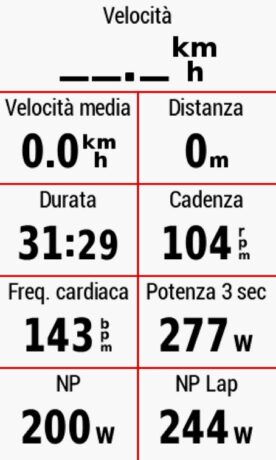 These three parameters are the most useful for the coach to build a workout and for you to be able to follow it and be aware at every moment of your pedaling of what kind of effort you are sustaining. Summarizing in very few and simple words, we can consider heart rate as the parameter by which you can measure your internal load in medium- and long-duration efforts. Cadence tells you how you are delivering your effort: for the same amount of power delivered at low cadence you employ a greater component of muscular strength while at high cadence you will use rotational speed and thus greater coordination and cardiac effort. Power is the only objective and reliable measure of the effort you are delivering whether for a duration of a few seconds or for a 20-kilometer climb. In the attached image you can see the values I recommend entering on the first screen of your GPS. In this case, the first three values are zero because the screenshot was taken during indoor training.
The other benefit of technology applied to cycling we are experiencing inIndoor Cycling. Today you have the opportunity to perform quality workouts in minutes and with absolute safety using state-of-the-art mopeds (or home smart trainers) and advanced training management software. These tools have become an essential support for your seasonal preparation as well as for professionals. Smart trainers can display cadence, power and heart rate at every moment of the workout. Everything you need to train at your best.
The choice of instrument
The first thing you need to do is to purchase the trainer to use for your workouts. From a structural point of view you can choose between rollers and mopeds. In the former you connect the entire bicycle to the trainer and your wheel slides on a rubber roller. The sensation in pedaling is rather “rubbery,” and at instantaneous and very intense changes there is often a loss of grip of the wheel, which tends to slip. Personally, I prefer the moped.
Mechanically, you have to detach the rear wheel of the bike and connect the chain to the sprocket pack installed on the trainer itself. In this way, the pedaling sensation is much closer to the real sensation you feel on the road. Since your chain is tied directly to the cyclomill you will always have maximum control and, above all, an exact perception of the effort you are sustaining. There is no tire slippage and therefore no delay in power delivery.
From a technological point of view, on the other hand, you can choose between Smart Trainers that are able to send all your workout data and those that are also able to receive instructions. You got it right. The new technology allows you to use a moped that is able to automatically change its resistance in case you need to simulate a climb in a virtual course or enter a high-intensity repeat using a training file.
A smart trainer to function needs software with which it can communicate. The software can be used with two different systems. In the traditional version you maintain control of intensity by using the bike’s gearbox and changing gears whenever you need to increase (with longer gears) or decrease (with shorter gears) intensity. The second version widely used in recent years is the controllable version.
This way you don’t need to use the gearbox because it’s the software itself-Zwift, to name the best known-that sends instructions to the cyclomill allows it to change the resistance to suit the needs of each instant of your training. In other words, the software can send an entire workout to the cyclomill and “force” you to do it without the ability to change it or vary the intensities of its phases. This feature especially helps those who tend to lose concentration in indoor workouts, but more importantly it makes very fast changes in intensity possible without having to waste seconds in changing sprockets and pinions and waiting for the trainer’s mechanical response.
Once you have purchased the trainer and chosen the software to use what you need is a training program tailored to your goals and capabilities.
I am opposed to those who use indoor cycling for casual pedaling or even worse, to participate in virtual group rides to always and at every opportunity compete with other cyclists going to unnecessarily wear out their hearts, heads and muscles. It is necessary to alternate training stimuli by devoting oneself to the kind of workouts that are difficult to do on the road. Privileges in indoor maximum strength development and technical aspects. Instead, leave the aerobic base and metabolic stimulation to your weekend road trips.
(Main image photo: robertprzybysz on depositphotos.com)