
One of the main goals of my work is to be able to find innovative and individualized solutions to get the tools and stimuli you need to grow in technical and performance terms. Periodically we can do follow-up tests, either in the laboratory or in the field, to evaluate and measure actual performance growth.
In triathlon, the evaluation parameters can be many and especially different for each of the three disciplines that comprise it. Timed times over different distances, number of strokes per pool or swolf for swimming; more complex and articulated functional assessment tests for running and biking. But at the end of the day, what matters most to both you as an athlete and me as a coach is to make you go harder: fewer seconds per km in running, higher watts/kg in biking etc etc…
What are you willing to do to improve your training?
Over time, in order to improve, you are willing to increase both the volume and intensity of your workouts. But this strategy often turns out to be wrong because of all the consequences this can have in terms of overtraining, risk of injury and mental and physical stress. This situation also occurs very often in triathlons where you have a tendency to train too much or at least more than necessary. So many times then, to support the excessive physical and psychological load, you exaggerate in chemical supplementation.
Is there an alternative to this?
Surely streamlining each training plan and planning over the medium to long term would improve the situation. The work done over the years within our practice has led us to realize that for most amateurs there is a better solution. Gradual increase in training load both in terms of volume and intensity can be accompanied and supported by the strategy related to your body mass: improvement of lean mass/fat mass ratio combined with an eventual, but not always necessary, overall reduction in body weight. A good result in this direction combined with a well-structured training plan will enable you to arrive at interesting results in significantly less time than if you work solely on the training plan.
Our work protocol involves an initial body composition assessment that includes estimation of fat mass, lean mass, hydration, and basal metabolic rate. Estimates are made using bioimpedance analysis, which is a reliable, noninvasive, and easy-to-use technology. An eating plan designed for your specific needs allows us to work on your body composition to achieve significant results within just a few months. Proper nutrition improves digestive efficiency, reduces overall inflammation levels, thus allowing for higher performance in your workouts and also better post-workout or competition recovery. The goal is to trigger a virtuous cycle between body composition and performance. You should also not overlook the very positive impact that a reduction in fat mass and weight has because of the less difficulty you will have in training and achieving certain chronometric performances.
The benefits of this work can go in two different directions:
- loss of fat mass balanced by an increase in lean mass and thus muscle mass (weight almost unchanged);
- Loss of fat mass along with loss of body weight.
In the first case, I’ll show you the data of a good Age Group triathlete who in two months of work against an almost unchanged total weight showed an almost equal replacement of fat mass and lean mass in favor of the latter. This means in practical terms that the athlete has eliminated about 3 kilograms of ballast and can take advantage of a body with significantly greater displacement (increased lean mass and muscle mass). In addition to an increase in performance, the subject also showed a noticeable physical transformation by achieving better muscle tone and definition.
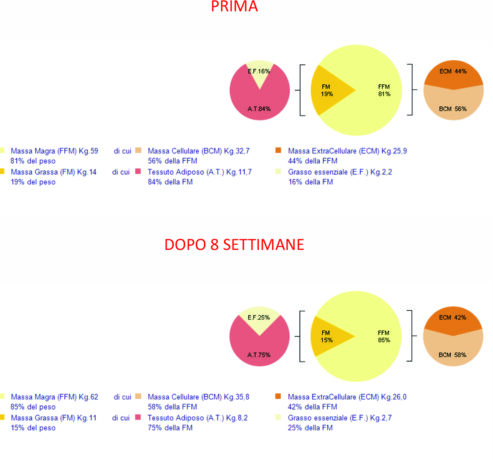
| Dates | Weight | TBW | FM |
MM |
BMR |
| FEBRUARY 1. | 72,5 | 42,9 | 13,8 |
40,1 |
1700 |
| MARCH 25 | 72,7 | 45,2 | 10,8 |
43,6 |
1789 |
(weight: weight; TBW: total hydration; FM: fat mass; MM: muscle mass; BMR: basal metabolic rate)
The second example, on the other hand, concerns a simultaneous loss of fat mass and weight for a modest gain in lean mass. A measure of the progress that can be achieved here emerges from two functional assessment tests for cycling taken 3 months apart. The athlete achieved in the two tests a maximum peak power in the incremental test of 330 and 340 watts, respectively, but at quite different body weights. This competitive athlete, already trained, at the first test lost 4 kg in 3 months. This implies, in terms of performance, a major improvement: in the first test 330 watts peak for 82.5 kg means 4 watts/kg. Instead, in the second test 340 peak watts for 78.5 kg means 4.33 watts/kg. So a 3% increase in peak power through a targeted diet plan resulted in an overall watt/kg increase of 8.25%!!! To achieve the same increase in watts/kg without losing weight would require an increase in peak power of 12%, which is really difficult in three months for an already trained athlete.

| Dates | Weight | TBW | FM |
MM |
BMR |
| JANUARY 04. | 82,5 | 48,2 | 16,9 |
45,3 |
1825,5 |
| APRIL 24 | 78,5 | 50,3 | 10,2 |
47,0 |
1867 |
(weight: weight; TBW: total hydration; FM: fat mass; MM: muscle mass; BMR: basal metabolic rate)
These examples show how efficient management of nutritional composition can enable both direct and indirect increases in your absolute performance.
The practical experience of our study is, of course, corroborated by numerous scientific papers that emphasize the advantage in sports performance of contained fat mass and developed active cellular mass. For example, a study by the University of Rome ‘Tor Vergata’ showed an inversely proportional relationship between the time achieved in a marathon and the amount of cellular mass (one of the indicators of lean mass).
Consider the food plan as part of your training program from today, and you will have an effective tool for your health and improved performance.
(Main image credits: AntonMatyukha on DepositPhotos.com)