
At Cortina, during the LUT, Artcrafts built something hard to define. Not a stand. Not an event. A thematic, narrative path through the world of ultra running — curated like an exhibition, experienced like a gathering.
There are moments of transition. Moments when a discipline stops being a niche and becomes a cultural indicator. For ultra running, that moment is now. Rachel Entrekin’s victory at Cocodona 250 shifted the axis: no longer just elite athletes in remote places, but a new generation of runners carrying a precise question. Not just how fast. How.
In this space — between performance and aesthetics, between technique and meaning — the most interesting brands in the sector are moving. Artcrafts brought them together in one place.
During the Lavaredo Ultra Trail, in Cortina, in the design spaces of Hotel de Len, CASA ULTRA opened for two days.
It wasn’t a stand. It was a path.
The Logic of Selection
Cortina during the LUT is not Cortina. It’s another city — temporary, frantic, layered over the real one. Brands line the main streets, social runs overlap with race timing, gazebos multiply, the Expo looks like a souk. Everyone tries to shout louder than the next. The problem is that when everyone shouts at once, no one hears anything.
CASA ULTRA was two hundred meters from the main street, partially hidden. Physically lateral, tucked away, deliberately discreet. Faraway, so close.
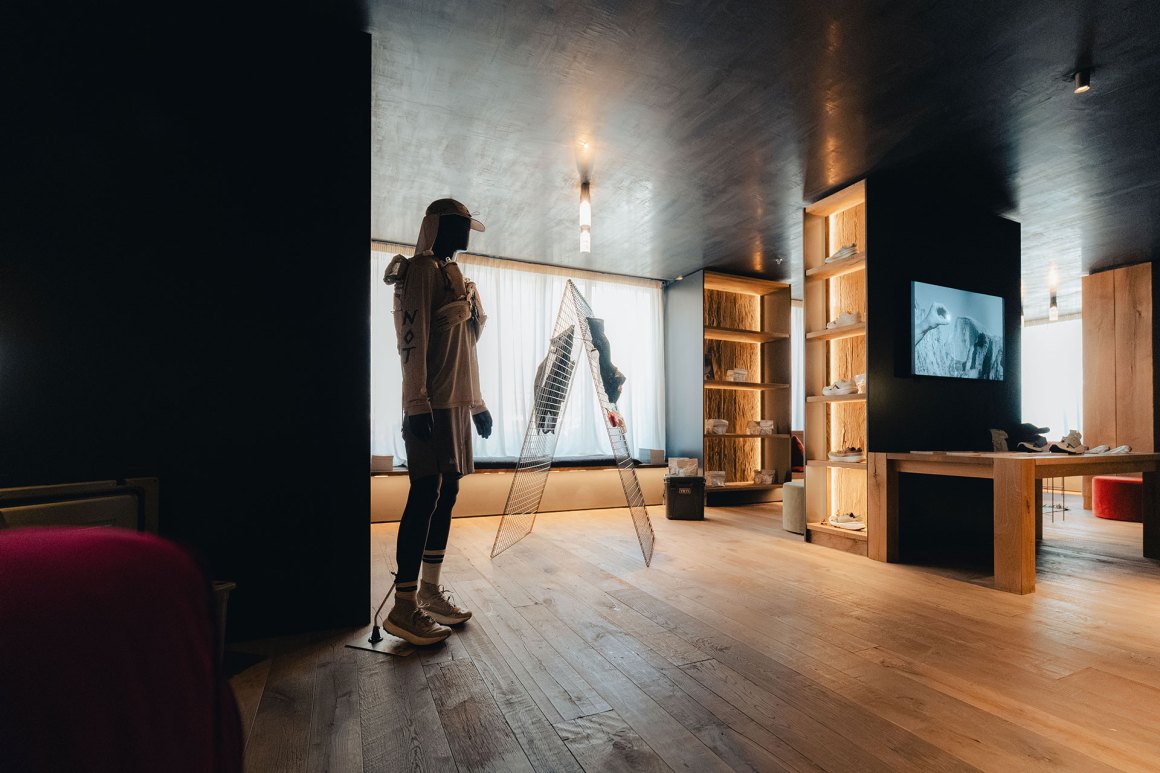
The setup was that of a living room — low tables, seating, a thematic path — not a stand. No frontal display, no sample inventory. A selection.
Above all, the criterion was not brand recognition, nor budget size. It was position, attitude. Which brands have something to say, not just something to sell. Which have a vision that unites performance excellence and aesthetic awareness — and hold it, even under commercial pressure.


The Brand That Started It All
Artcrafts distributes Norda. And at CASA ULTRA, Norda was the guest of honour in a precise sense: not as a presenter, but as a reference point. The brand that gave an aesthetic vocabulary to something that was previously only technical, that convinced a certain kind of runner that form matters as much as function.
The 055 — releasing in early July — arrived as a reserved preview, accessible to press who knew where to look. The model numbering follows the Fibonacci sequence: 001, 002, 003, 005, 055. Not a decorative detail. It’s how the brand measures its own progress — each model an evolution on the same track, brought to a different level of performance and thought. Where 001 and 002 maintain openness to broader use, 055 is a race product in the most technical sense of the term, running parallel to 005.
Showing it here was a gesture. A recognition of the trailblazer of this conversation. There will be time to go deeper into the 055 another time.

The Path
What does it mean to rethink equipment? Mount to Coast was present with its full collection and with the M1 as a preview: the brand’s second trail model after the T1, in a range that already covers road with R1 and C1, and gravel with H1. Alongside the shoes, a photography exhibition: 100 An Ultra Journey, created with Souplesse, documents the Roman run club’s racing unit running the 100km del Passatore for the first time. Not photographers documenting athletes. People telling their own story. Wise, a French start-up, completed the picture with vests and packs organised by objective: run, hike, walk, ultra. A distinction that only makes sense when the person making it knows the difference from the inside. Ciele added a more communicative key: colour, form, contemporary identity.
A few metres away, the territory shifted. Wild Tee displayed the Not Now capsule worn by Filippo Canetta at the Marathon des Sables. The original one, never washed after the race. Ultra-lightweight, ultra-breathable, odour-resistant fabric, designed for the most extreme climates. A sartorial argument from someone who has run that race, not imagined it. Akta — an independent Italian producer of freeze-dried meals — occupied the same territory from a different angle. Friday’s lunch didn’t look like an emergency ration. It looked like a real meal. Both start from the same premise: understanding what you truly need requires having lived it.
All around, the community. Alba Optics has built a community so organic that the line between brand and people becomes nearly invisible — every day, a volume of user-generated content that is, in the words of those who know the numbers, staggering. Yeti was present with the coolers that appear at aid stations of ultras around the world: a silent recognition of those who run without a race number. On Thursday afternoon, Michele Giusti of Ragma Works opened a reflection on the relationship between runners and the materials they use. The starting point: more and more runners draw, write, leave marks on the soles of their shoes. A gesture that turns a tool into a document — a dialogue between meanings, experiences, aesthetics. From there, the step toward upcycling is logical: what happens to these objects when they reach the end of their cycle, and whether there’s a way not to waste them.


A Stand Is a Monologue
A stand is a monologue. CASA ULTRA was a conversation. Everything can be summed up in those few words.
On the afternoon of June 25th, Filippo Canetta spoke about the Marathon des Sables. Not the product — the experience. The capsule, the process, the thinking of a runner who decided to build something from what he had lived. The following day, Buckled’s live podcast dedicated an hour to the Western States Endurance Run: data, opinions, analysis, the race as an object of study, while the actual competition would begin twenty-four hours later.
No one talked about brands. The brands were there, woven into the conversation, without needing to introduce themselves.
Ialty’s specialty coffee, Akta’s tasting, product trials. A place designed to stop, not to pass through.
Worth noting is the one deliberate absence, because it matters. The sound installation Artcrafts had planned — an audio layer designed to create conditions for slowdown — wasn’t there. Not because the idea was wrong or out of place (quite the opposite), but because there wasn’t time to realise it at the level they wanted. It’s a detail that says something about the project as a whole: CASA ULTRA operates with a self-imposed quality threshold. Better not to do it than to do it badly. Better excellence than settling.


A Format, Not an Event
CASA ULTRA in Cortina was not a destination. It was an archetype.
The next stop might be a race, or it might not. It could be an electronic music festival — where the audience that listens and the one that runs is often the same person. It could be a major city. The ultra running community has no boundaries, because it doesn’t belong to a single context. The same person who runs the LUT today goes to a festival tomorrow, and is back in the city the day after. The format works wherever someone is willing to stop for a moment and start talking.
The gigantism of running events will keep growing. The gazebos will multiply, the social runs will increase, the noise will get denser. CASA ULTRA has found, for now, its corner. Lateral. Discreet. Impossible to ignore, if you know where to look.