Portrait of a man who spent six years as the keeper of a dam, and who turned that isolation into a subject of study. All the way to the loudest finishing straight in trail running.
In Chamonix, in the week before UTMB, the air is cool and still impossible to breathe. The valley fills until it splits, everyone has already arrived and nobody has run yet, and for a few days the town turns into a waiting room with Mont Blanc resting on top of it. It’s the week that ended up organising everyone else’s calendar, and it’s also the moment Kailas FUGA chose to open its first European store, a few metres from the point where, shortly afterwards, every one of them would pass.
That’s where I sat down with Cristian Minoggio. Forty-two years old, lean build, the manner of a man who answers one question at a time and hands you a whole world. He lives without a television. At his house the phone finds a signal only if you go down a floor.
In the noisiest place of the year, the quietest man in the room.
Summers on the Alp
His story starts a long way before the running. He grew up in Cannobio, on Lake Maggiore, with his grandparents: his parents commuted across the border into Switzerland, and as soon as school finished in June everyone went up to the baita, the summer mountain hut, with the animals and stayed on the high pasture until September. His job, in the morning, was to collect the shopping list from the families up there, walk down to Finero, run the errands, climb back. In the evening they went to fetch the goats. In between he helped his grandmother with the cheese curd.
Then adolescence did its work. Parties, electronic music, the sort of boy a village writes off as drifting, and who at half past seven on a Saturday morning was on a building site. He had chosen labouring for a reason that now reads like a statement of poetics: he liked physical effort, and he wanted a job that would give him some.
At twenty-two, over the Christmas break, with the sites shut and nothing to do, he went down to the cellar and dug out a pair of old iron crampons. He climbed a small summit above the house, one of those that appear on no list. He sat down on a cairn of stacked stones and looked down. He says a very simple thought arrived: that there was a great deal to see, and that he was spending his days shut inside four walls.
From there he could have gone any number of ways. He chose the CAI, the Italian Alpine Club, because it was full of older people who teach you how to move in the mountains and what kind of respect the place is owed. It’s the choice of an apprentice rather than of a twenty-two-year-old chasing adrenaline.
Six Years on the Dam
For six years he was the keeper of a dam at two thousand five hundred metres. A week up there working, Tuesday to Tuesday, then a week down in the valley. There wasn’t much free time and there was almost nobody; there was the weather, the environment, conditions that shift ten degrees in an afternoon, and the animals.
When he talks about it, he reduces the whole thing to three words: you learn solitude.
The weight sits in the verb. You learn it the way you learn a language or how to service an engine: with a subject, some mistakes, something that corrects you, and a great deal of time. Most of us treat being alone as a weather condition, something that arrives and that you wait out. There’s a linguistic reason for that as well, and it counts for more than it looks. Paul Tillich, in a collection of sermons called The Eternal Now, observed that English keeps two words where Italian has one: loneliness for the pain of being alone, solitude for the grandeur of the same condition. Italian hands the whole word, solitudine, to the painful half. Say in Italian that a man lives in solitude and nobody assumes he’s studying.
He studied, and the syllabus was environmental long before it was psychological.
A marmot that whistles once is flagging a person; two whistles mean something flying above it. Young eagles, when they settle on a ridge instead of gliding, are telling you something about the sky behind your back. Once he was climbing towards a three-thousand-metre summit, the Swiss side was dark, and he watched two of them settle on the rock above him: he turned round fifty metres below the top, and five minutes later lightning took the exact spot where he would have been standing. In the morning, before going out, he looks at the flag in front of the house pulling south and the cloud on the summits pulling north, and from that contradiction he works out how much time he has.
No forecast returns that degree of local precision. And it’s information that accumulates only when there’s nobody to subcontract your attention to: with two of you, someone delegates — one watches the path, the other watches the clock. Alone you delegate nothing, and for that reason, he says, there are sections he takes more calmly on his own than in company. With two, one lends courage to the other, and borrowed courage carries you where your body that day would never have gone.
For the summer season he now lives at Riale, in the Formazza valley, near the Toce waterfall, in a flat inside a building that closes for the winter. He’s been told that in the cold months the lights come on by themselves, and that somebody swears there’s a ghost. He’d like to stay a winter and check.
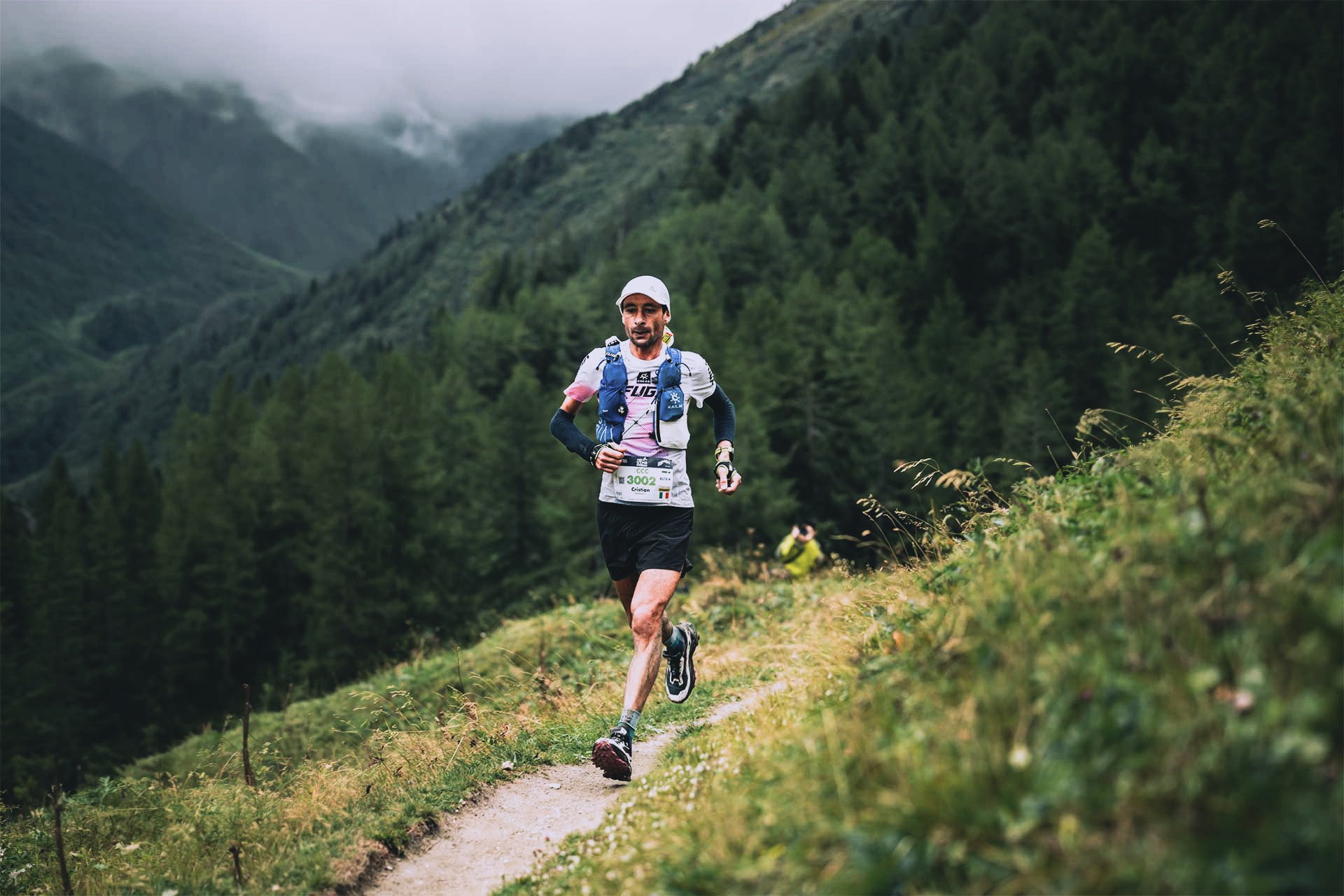
The day starts without an alarm, with oats, protein, barley, honey and almonds, then a walk in the FUGA YAO SPEED, the most minimal shoes he owns, to fetch coffee at the refuge further up the valley, with a few mobility exercises done on the road as he goes. The average is thirty-five kilometres a day. Once a week he swims. He hands you a large truth without ceremony: we were born to climb, to walk and to swim, and running turned up as a way to escape or to find something to eat.
The Limit Gets Remeasured Every Morning
We’ve been trained to read the limit as a number. Threshold, average uphill pace, the vertical gain a week can carry, the percentage of a one-rep max. Useful numbers, with a side effect: we mistake them for a biographical feature, something that describes us the way height or blood type does. In his account the limit is a measurement taken again every morning, rather than a value printed on a person once and for all.
The same rock step, the same exposed ledge: there are days when he does it and days when he turns back, and the difference can sit in how much sugar is circulating in his body. With low blood sugar the reflexes slow and the foot lands a tenth of a second late. Caffeine brings it forward, but it carries a confidence that hasn’t been earned, and on a ledge artificial courage is as poor an advisor as fear. Better the adrenaline of a storm you’re running from, he says, than the adrenaline of an espresso.
No training plan knows his Tuesday.
If the measurement is retaken daily, the instrument that takes it has to stay switched on, and here the conversation arrives at the feet. On the most technical outings he uses the YAO Speed, the most sensitive model in the Kailas FUGA range, the one that lets the ground arrive almost whole. On long trail, the FUGA EX PRO, which supports the mechanics of running and gives propulsion back to the stride on the runnable sections without switching off the mobility of the foot, which has to keep adapting in every direction. The detail he recounts with most conviction covers twenty years of personal history: running in very bare shoes he accumulated swelling in his ankles and feet, and once cushioning came in that bill stopped arriving. He says that if they had existed earlier, he’d have a few fewer problems today. The EX PRO family has kept evolving along this same line of tension between listening and protection.
The Boy Under the Podium
There’s an image that keeps returning when you ask him where all of this comes from, and it has nothing to do with the mountains.
Twenty years ago he was finishing twentieth. Once the race was over he’d park himself under the prize-giving stage and stay there watching, while the announcer called out other people’s names, thinking that one day he’d be up there too and would look at the crowd from the opposite side. He describes it as something that wore at him, and the anecdote is more representative than it sounds: it describes a man who spent years standing outside something, still watching it, still leaning towards it.
When I ask him what he’d say to a young runner starting now, the answer is flat.
Earn it!
Because for anyone who arrives already gifted the thing comes easily, and what comes easily bores you sooner or later; what you’ve earned, you never put down. You’re born a professional rather than becoming one, he adds: if you love something all the way down, you’re doing it professionally long before anyone pays you for it. Since December he’s been one on paper as well, with a contract with Kailas FUGA.
The same principle, curiously, governs his relationship with the company. He receives shoes to test, uses them until they’re finished, then sends them back instead of photographing them. A wrecked shoe holds information a photograph doesn’t: where it split, which lug wore through first, which seam gave way under a body loading thirty-five to fifty kilometres a day. At the factory they open them up and reinforce those points. It’s the same apprenticeship cycle he went through himself, moved across to the industrial side: a subject, a mistake, something that corrects you, some time.
The Finishing Straight
A few days after that conversation, on the Friday of the same week, a storm forced the organisers to push the UTMB start back by hours. Thousands of people who by then should have been out on the trails were still in town. Two and a half thousand competitors waiting, barriers full, the centre of Chamonix compressed into a single corridor of voices.
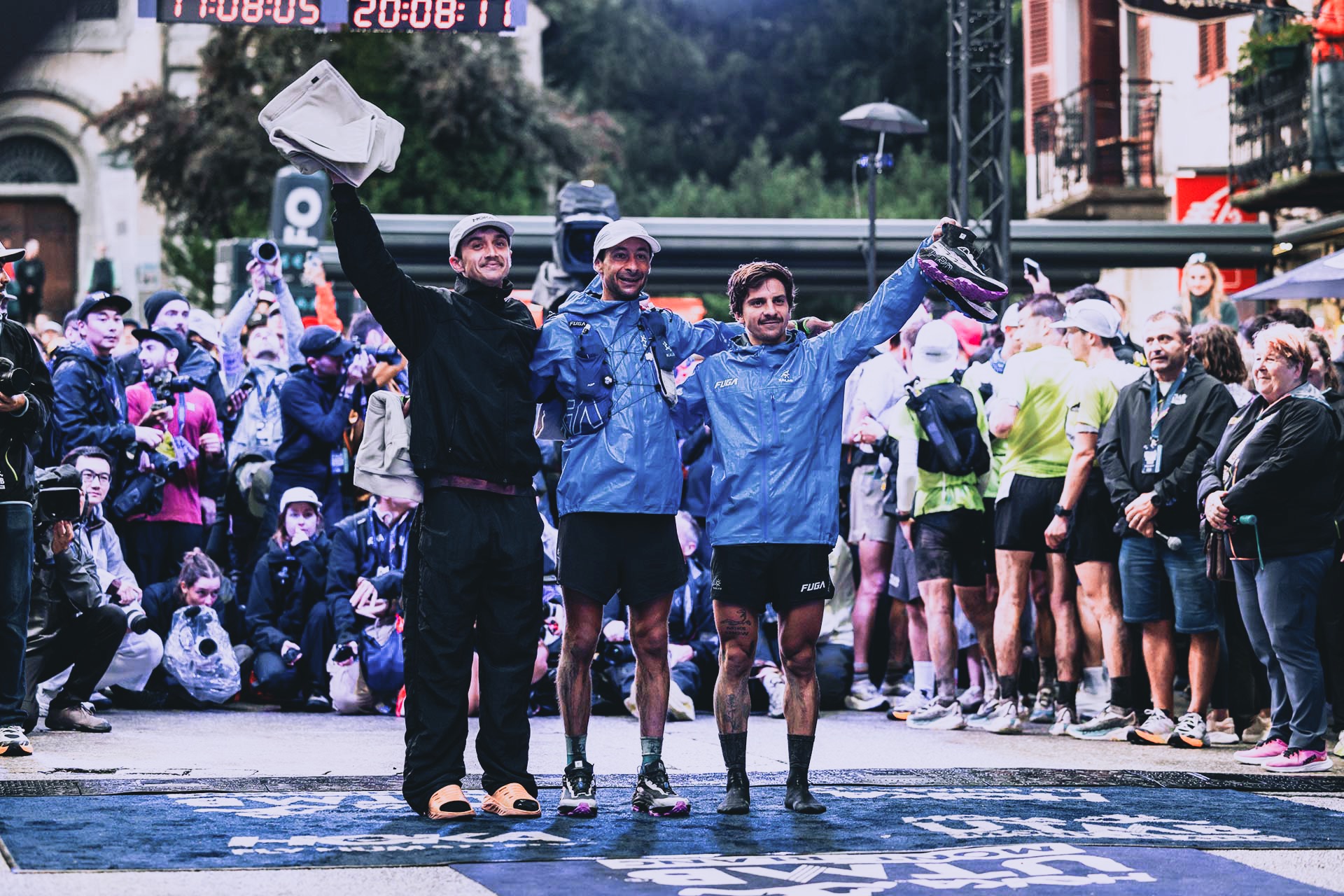
Minoggio entered that corridor as the winner of the CCC, with the EX PRO on his feet, after ten hours and twenty-one minutes and a hundred and seven kilometres. He ran the second half at the front and closed down a finishing straight that nobody had designed for him. But that he knew was his.
The man who learned solitude won his most important race in the most crowded place he could possibly have arrived at. And that piece of stage design was built by the same phenomenon the eagles, years earlier, had taught him to read five minutes in advance.