What connects hundreds of people running at 160 bpm from London to Barcelona? An identical social ritual, replicated across every major city in the world, that brings everyone together.
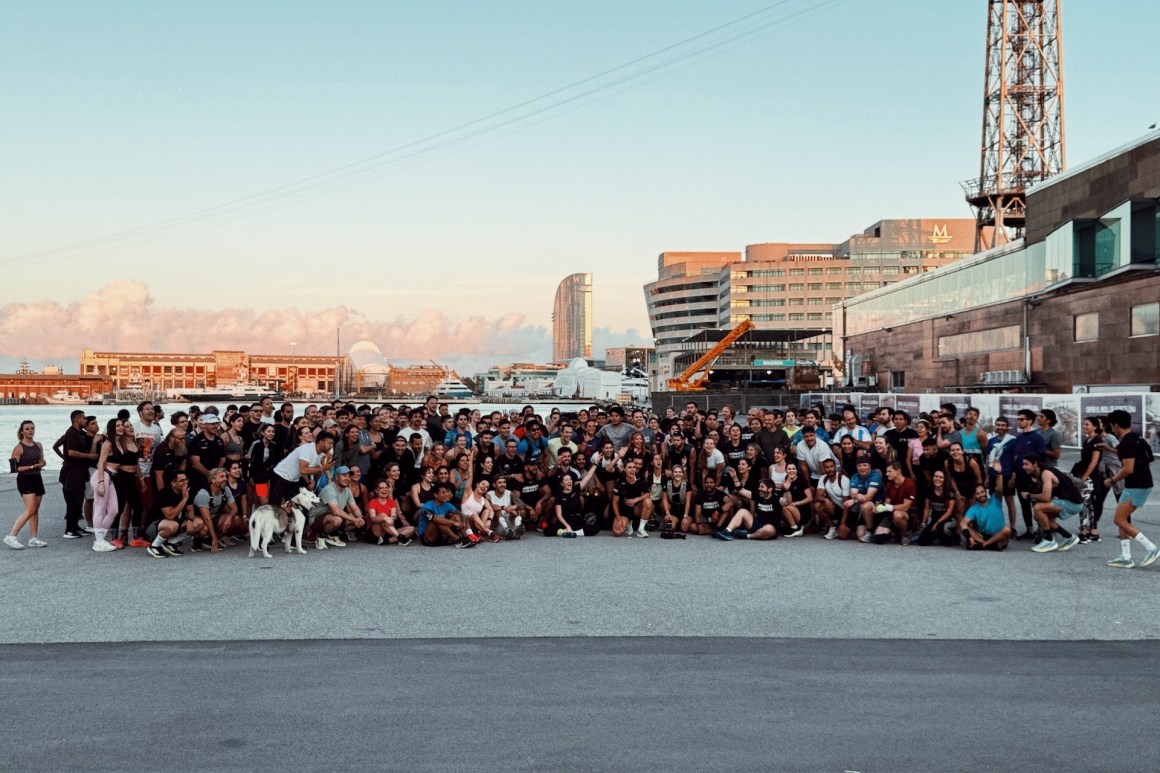
When I show up, there aren’t many people. We’re still about twenty minutes out — I figure more will come. I expected a bigger crowd. One of the Midnight Runners Barcelona organizers is already here. We introduce ourselves and I ask if I can take photos. “Of course, everyone wants them taken — you don’t even need to ask.” More people arrive. Maybe it’s a slow night, I think — they’re probably somewhere else. And yet I’d been told these events were always packed. I take a few shots. Some people have dogs. One of them is gnawing on a stick; another is getting a pat on the neck from whoever reaches out.


About ten minutes to go — it’s supposed to kick off at 8:00 PM. I look up from my watch and for a second think there’s a flash mob underway. Dozens of people have materialized in front of the meeting spot from what seems like nowhere, the way cities fill a space the moment something calls them to it.
I keep shooting and listening in on conversations, trying to piece together who these people are, what their story is. Most of them look to be in their 30s — I think I might be one of the older ones here.
Some are clearly expats, talking about travels and where else they’ve run. Probably other Midnight Runners chapters, in other cities. There are eighteen of them around the world.
The Paradox of the Crowd
Midnight Runners don’t work in spite of their scale — they work because of it. We tend to assume small groups are more welcoming, that intimacy is what creates connection. Here it works the other way around: the crowd is the shelter, not the obstacle. The anonymity of large numbers lowers the barrier to entry for everyone — the shy one, the expat who landed three months ago, the person who hasn’t found their crew in the city yet. You can ease in without any obligation to hold up a conversation until you’re ready.


But this isn’t, as people often say, a reaction against social media. It’s their physical translation, played out on asphalt. I found them by Googling running clubs in Barcelona, then reaching out directly on Instagram. Running clubs — the narrative has been around for a while now — are the answer to dating apps. More than that: they’re better, because they make room for a real-world experience with many people united by the same interest, bypassing the limits of the digital version. But the truth is more layered than that. We’re not watching a pushback against social networks — we’re watching their physical translation, out on the street.
Midnight Runners work because they apply the logic of the digital experience to urban space. The Heylo app connects people and tells them where to show up; the group run is the feed in motion; the music at 160 bpm blasting from shoulder-mounted speakers is the constant notification that keeps dopamine and engagement levels high; and the bodyweight exercise breaks become the moments of guided interaction — the “comments” and “likes” translated into collective planks and burpees. This isn’t an alternative to the smartphone. It’s the algorithm made flesh, sweat, and running shoes.
The movement was born in London in 2015, and a social platform was part of how it happened. Two friends, not exactly fired up about training through a grey British winter, decide that a social commitment is worth more than any training plan. They post on Meetup.com. Thirteen people show up. Eleven years later, that format has replicated itself from Buenos Aires to Sydney, from Berlin to Milan — all the way to the 150 people I’m running with tonight in Barcelona.
A Global Format
It’s no coincidence that this took root above all in major international cities. The thirty-something who touches down in a new city doesn’t find unexpected urban exploration here — they find something more useful: a preset protocol, the same codes, the same structure, even the same bpm, anywhere in the world.


In this context, running and exercise undergo a polarity reversal: you don’t get together to move — you move to get together. Athletic performance steps aside, replaced by a collective experience that, in uncertain and unstable times, is a solid answer. Wherever there’s a Midnight Runners chapter, you can meet people with similar interests in a format that never changes. In a world where jobs, homes, and relationships are all precarious, finding an identical protocol everywhere you go is a therapeutic resource — solid ground under your feet.
Never Just Running
Why does their formula work so well? Because it’s choreographed. There’s a warm-up right from the start. The music blasting from large speakers carried on the shoulders of some of the organizers isn’t just background: it’s there to spread energy, yes, but also to drive core exercises at 160 bpm. You’re dancing and working out — or maybe it’s the other way around. Doesn’t matter.
As I run, I notice that the tracks are picked to keep the whole group in sync — no one falls out of time. When you’re moving with the others, the music you hear translates into a precise physical dynamic: the shape of your legs, then your feet hammering the road. Tap tap tap. In perfect sync.


At each stop, the faster runners do more reps while the slower ones close the gap. The result is that the group never splits apart. You don’t watch the fast people vanish over the horizon — everyone leaves together, everyone arrives together. It’s a simple mechanism with one precise consequence: you end up doing exercises next to the same people you just ran with, and if you didn’t know them at the start, you get to know them by sweating alongside them, dancing, talking. Their official motto is “Never Just Running” — and it’s one of the most accurate descriptions you could give this running club.
It’s not a race, it’s not a gym session, it’s not happy hour. It’s a hybrid that didn’t have a name yet — one that clearly fills a need many people were looking for without knowing it. Being together, getting to know people while doing something good for you, laughing through a badly executed burpee and then running anyway: that’s a type of experience that doesn’t translate online.


Around Midnight
For the final exercise, everyone forms concentric circles, arms around each other’s shoulders. By now, everyone knows the person next to them. It doesn’t matter if they first laid eyes on each other an hour ago — you start together, you finish together.
The gesture of the embrace carries real weight, and I don’t think it’s accidental that it comes at the end. It’s the final act of a story that began on a smartphone — someone searching for people to go running with. The digital has become real and taken the shape of bodies drawing close and making contact. No: running clubs are only the antidote to social media addiction in the journalistic shorthand version. What they actually do is give apps a purpose, a use.


It’s dark now. I don’t know how many of them met for the first time tonight and how many already knew each other. Doesn’t matter, in the end — or maybe it matters enormously, and that’s exactly the point: here, you can’t tell the difference.
But the final act isn’t this. It’s the hangout — which is also the starting point. There’s food and drinks, courtesy of the sponsor brands, and people stay. And that’s when I notice something: almost no one has their phone out. A few people snap a photo, but mostly people are talking, drinking, eating. They’re here, in the present of that same physical space — actually present, not physically there but mentally somewhere else. And that alone is something. Really something.
Info
In Barcelona, Midnight Runners meets every Wednesday at 8:00 PM for a 6 km route with three exercise stops. Participation is free. Sign up through the Heylo app. The site midnightrunners.com lists all active cities.
Fitness level required: none in particular.