
In planning training to prepare for a race, but it is a valid discussion more generally for those who run or play any sport-even amateur, one of the most important things to make room for on a calendar day is a sports-medical checkup to see if one’s physical and health status is adequate.
Medical-sports fitness is mandatory in Italy
in order to participate in competitions, so it is a necessity for those who want to run in competitions, but even if we simply want to do our solo running it is good to undergo an examination. There are a plethora of medical centers where you can get it done, scattered all over Italy, with varying costs depending on the city and whether or not you have an agreement with your sports club or FIDAL, but it is an expense to incur once a year for our health and to be more comfortable when we run, so I always find them money absolutely well spent and worth the equivalent of the one or two less pizzas in a year. The very good thing is that having a sports-medical examination doesn’t involve any disruption of our routine and training plan, so it can be inserted practically at random into our schedule – here, maybe not the day before the race, but I mean, you get the idea, right?
Something that is just as important as the sports physical, but instead should be planned much more carefully to fit it into the training schedule, is the day you go to
donating blood
. Whole blood donation, in fact, can affect our physical abilities, so it is good to pay due regard to this practice.
WHAT IS A BLOOD DONATION?
Technically, blood donation consists of voluntarily and freely submitting to the withdrawal of a specified amount of blood from the bloodstream to provide it for medical research. Up to this point I think it is something known to everyone and also easily imaginable. In the most common understanding, when we talk about.
donate blood
, we mean the donation by which a donor person provides blood to be able to
transfuse
to a recipient person who needs it. Each of us has a blood type that is genetically and hereditarily determined (the most common cataloging system is based on the AB0 antigens, for which 4 basic groups are recognized: 0, A, B, and AB, depending on the various possible antigenic combinations) and blood transfusion must follow certain rules in order to be performed safely. Among the things that are done
routinely
e
preventively
to any use of donated blood, there are a whole series of analyses for quality and health parameters that allow a judgment to be made as to whether the donated blood is usable or not. Moreover, very rarely is donated blood stored in its entirety, but is usually divided into its various physical components (red blood cells, platelets, plasma, etc.) to prolong its shelf life. There would be hours to talk and write about these technical aspects, but perhaps I would be a bit boring, so let’s gloss over it. Anyway, the important thing to know is that in standard donation, between 440 and 480 mL of blood is taken from our bodies and stored inside one or more sterile, disposable bags.
WHO CAN DONATE BLOOD?
In Italy, blood donation is regulated by the Law October 21, 2005 , no. 219 and its subsequent amendments, which provides that only individuals of legal age, of either sex, who have voluntarily expressed an intention to undergo donation may donate.
The procedure is disarmingly easy: one goes-at this time better to make a reservation-to the blood transfusion center or bloodmobile (often found in busy squares and areas), fills out a medical history form with one’s data and basic recent and known health information, has an interview with a medical examination, and then lies down in the crib where the donation is physically performed. The sampling is venous and one of the veins on the inside of the elbow is usually chosen. This part is the part defined
bloody
, where the needle penetrates the skin. It is a matter of a split second, and the most you feel is a sensation like being pricked by a rose thorn or so. If you don’t look, you can hardly perceive it. Withdrawal takes about ten minutes, fifteen at most. After that, our donated blood bag will be ready to be analyzed and eventually made available. So far, the beneficial part of our gesture, which alone should be enough to make us schedule our
whole blood donation
semi-annual (for women) or quarterly (for men). It is also possible to donate only plasma or only platelets, and waiting times vary from case to case.
Now comes the part about our health. As mentioned, donated blood is tested before it can be made available and the test report is sent to the donor, which gives us an indirect picture of our health status. This, however, is the documentary framework, which is obviously useful and indispensable, and what don’t we see? What happens in our body after we have about half a liter of blood taken out? Once the body realizes that something is missing-and realizes it almost immediately-a process called
erythrogenesis
(o
erythropoiesis
) that in a few days will bring the number of red blood cells back to what they were prior to donation. This process happens all the time in our bodies, however following a blood draw the bone marrow-which is the main site where this process takes place-is more activated, producing large amounts of new, younger and stronger red blood cells than those already present. Following blood donation, there is also scientific evidence for an increase in circulating endorphins, resulting in improved mood. Donating blood, therefore, becomes a dual-purpose activity: we help others and ourselves, a more than fair exchange.
In addition, but this is only an indirect aspect, we are offered breakfast by the blood transfusion center, and under Italian law, donating blood is one of the basic rights of workers and requires that the donor have the day off.
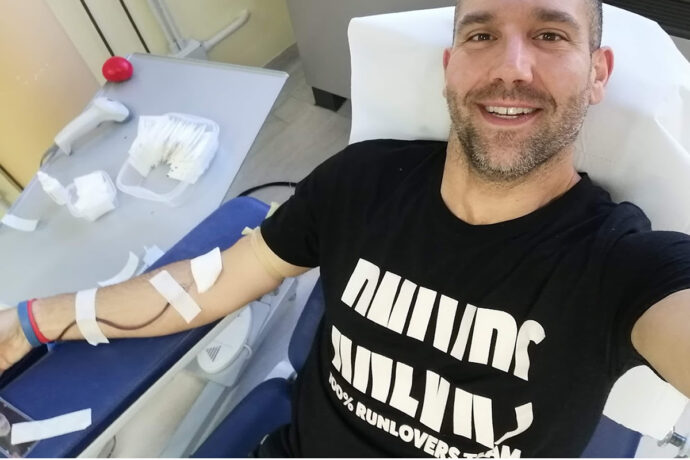
BUT HOW LONG AFTER THAT WILL I BE ABLE TO RUN AGAIN?
And there it is, the question that every runner who wants to donate blood asks the doctor:
How long after donation will I be able to run again?
For this there is no one answer because there are multiple factors that come into play, but still, two macrocategories of whole blood donor runners can be pointed out: low-intensity and high-intensity.
For those who practice running (or any other endurance sport) at low intensity, with three or four runs per week and not excessive exertion, AVIS Italy suggests a day (at most two) of rest, after which one can resume activity, still maintaining a gentle pace and with due attention to the perception of fatigue. In a few days your red blood cell count will return to normal, and if you do not exaggerate with the effort you can return to the level of your pre-donation days in about a week.
For athletes who train at high intensity, however, and for semi-professionals and professionals, things are a little different. Indeed, in such cases, the sports activity undergoes necessary planning changes. Greater exertion requires more energy consumption, but newly formed red blood cells are not yet able to carry the necessary amount of oxygen to the muscles, resulting in early fatigue and in some cases exhaustion. It will therefore take two to three weeks to return to pre-donation performance, and during this transition period it is advisable to conduct less heavy workouts with longer recoveries between intense sessions.
Some guidance can be provided that applies to everyone, both low- and high-intensity amateur runners, for the days before and the week after donation. Some small dietary tricks, such as drinking more than usual so that fluids are restored in less time and with less load on the renal system, increasing leafy vegetables and fresh fruits, and favoring protein-rich foods are widely recognized as facilitating recovery. From the point of view of training, however, it is wise to avoid overly intense workouts in the days before so that you do not end up with out-of-balance values in your blood (especially iron, cholesterol and hematocrit, which are extremely susceptible to change in these cases), and in the days afterwards it is wise not to schedule repeats, progressives or long distances.
Small things, ultimately, that with a little attention and planning are very doable and will allow us to run with greater awareness of our health condition and, why not, in a better mood for having done something doubly useful.
RunLovers who can, donate blood, at this time more than ever.
Partial bibliography:
The acute effects of whole blood donation on cardiorespiratory and haematological factors in exercise: A systematic review, by Johnson et al, doi: 10.1371/journal.pone.0215346
The effect of a standard whole blood donation on oxygen uptake and exercise capacity: a systematic review and meta-analysis, by Remoortel et al, doi: 10.1111/trf.13893
Analysis of pre- and post-donation haematological values in plateletpheresis donors, by Love et al, doi: 10.1111/j.1423-0410.1993.tb02150.x
Blood Flow Restriction Exercise in Sprinters and Endurance Runners, by Shingo et al, doi: 10.1249/MSS.0b013e31822f39b3