
For the past few years, some models of Garmin sportwatches have also been available in a “solar” variant, that is, with technology to increase battery life. Be careful, however: I wrote “increase the duration” and not “recharge.” Because the sun is not enough to fully recharge the battery; for that you will still have to use electricity through the appropriate charging cable.
How it works
As I mentioned, the system is designed to give you more battery life between charges and is especially useful in the U.S. brand’s smartwatches that are created for use devoted to long-distance endurance. Trail and ultra, in particular. In fact, not surprisingly, it is featured in the brand new Garmin Fenix 7, Instinct 2 and Enduro.
In particular, the Fenix has two variants: one with a Power Glass lens and one with Power Sapphire.
Operation is similar for both: there is a transparent photovoltaic solar panel glued under the watch lens that helps the device consume less battery power.
What is the difference between Power Glass and Power Sapphire lenses?
From an energy point of view, there is no difference; however, there is on the level of endurance. In fact, the Power Sapphire has a sapphire crystal lens for maximum scratch resistance. The Power Glass lens is always and obviously designed to resist scratches but is not comparable to the durability of the sapphire lens.
Constantly evolving technology
Garmin’s in-house technology is constantly evolving. In fact, Fenix 7, the latest addition to the Solar family, has more solar area (+54% more than Fenix 6X Pro Solar), more efficiency, and a more energy-efficient platform. What does this translate into? In increased device battery life ranging from +33% (in Smartwatch mode for the Fenix 7S model compared to the Fenix 6S) to +291% (in Max Battery GPS mode for the Fenix 7X model compared to the Fenix 6X).
Sunlight intensity is expressed on the clock face or Solar Intensity widget in the form of an icon that fills in as the light increases in intensity, as shown in the images below.
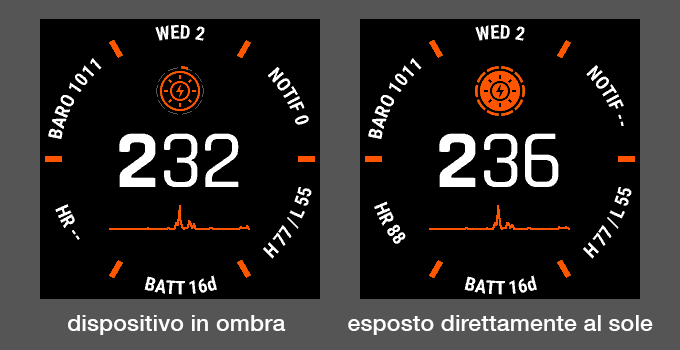
Clearly, the total consumption and charge duration of Solar devices varies depending on the active features and can go a long way. In fact, Garmin claims that in smartwatch mode and by wearing it all day (3 hours a day outdoors in 50,000 lux light conditions), the solar-charged version of the Instinct 2 has an unlimited lifespan. But it should also be specified that the latter has a more distinctly Lifestyle vocation.
How to make the most of solar charging?
As you can imagine to get the most out of it, it is advisable to face the watch lens directly toward the sun, avoid covering the watch lens with the sleeve, and wear the watch on the outside of the wrist.
However, there are factors that we cannot control directly but are still able to influence solar charging. Some have minimal impact, while others greatly affect charging efficiency. This is what I am referring to:
- Position of the sun, including time of day and current season as the distance from the sun can vary depending on how far we are from the equator;
- Weather, including clouds, rain and other weather events that can cover or obscure the sun; in fact, the optimal condition is to have at least 50,000 lux for at least 3 hours a day;
- Exceeding the optimal temperature thresholds for solar charging, 0 to 60°C;
- Charging from light sources other than the sun (as sportwatch lenses are optimized for the sunlight spectrum)
To whom is it recommended to have a Solar sportwatch?
The last question, the one you’ve probably been asking yourself since the beginning of this post: to whom is this technology recommended?
In my opinion, there are two assessments to be made. The first, and the simplest, is related to how you will use the device. If you anticipate very long releases to be recorded, then it is a more than recommended, almost mandatory choice.
On the other hand, however, we are in the presence of technology that makes our lives easier by reducing charging until we almost forget about it. Creating an even deeper gap from ordinary smartwatches.
The Garmin models currently in the catalog available with Solar variants and most common for endurance sports are: fēnix 7, fēnix 6, Instinct 2, Enduro and Instinct Solar.