
Among the questions that periodically pop up in the RunLovers Club on Facebook is the fateful “what is the best watch for running?” question, which in some cases sets off the tempers of those leaning toward one brand or another and one model or another. The real answer is. there is probably no such thing as the best watch for running, but it can exist the best compromise for each person’s characteristics, that is, and there is especially the possibility of identifying a few models that can please everyone in what we commonly call the “mid-range,” those products that are not really for beginners but also not at the top of performance.
Indeed, the device landscape in recent years has seen a crescendo of models, functions and, of course, prices. As with most things, with an increase in price comes an increase in the performance of the devices and the things we can do with them, but for the needs of an amateur runner such as you and I may be, whose predominant and almost exclusive sport is running, is there a watch that can present itself as a good compromise between performance and price? My personal answer is, “Yes, there is.” For about a month now I have been using, as a replacement for my beloved Garmin Fenix 3 (series that aesthetically remains the one with the best design, in my opinion), a Garmin Forerunner 245, one of the models of the advanced mid-range from Garmin, which is available in a standard version (the one I have) and a Music version, which has dedicated memory for storing music, a built-in player, and the ability to connect the device to a wifi network.
Hardware
The 245 is a light watch, weighing only 38.5 grams, and for me who was used to having the Fenix 3 on my wrist (which weighs 82 grams) in the first period I happened to think I had forgotten to wear it, even though I actually keep it on my wrist almost h24 and take it off only to wash and recharge it. It is constructed entirely of a carbon fiber reinforced polymer for the case, Gorilla Glass slide, and the strap is made of TPU, with a 22-mm quick-release coupling/uncoupling. The screen-to-case ratio is in favor of the screen, and once on the wrist the bezel and buttons seem to take up very little space, compared to other Garmin models. The display has a full circular shape with 240*240 pixels and 16 million colors. As is now customary, the design sees three side buttons on the left (one for power on/off/light and the two up/down movement buttons) and two on the right (one for task selection/confirmation/start/end and the second for back/lap).

On the back of the case are the set of sensors to detect heart rate at rest and during activity and the pulse oximeter, which records the percentage of hemoglobin bound in the blood (and indirectly, therefore, the amount of oxygen, to which hemoglobin normally binds). Next to these sensors is the charging block with the interlocking plug.
On the more interesting side for a watch that records our running activities, that is the GPS compartment, the 245 provides a wide choice of satellite tracking systems: GPS only system, GPS+Glonass, GPS+Galileo. To get an idea of the efficiency of one or the other, I tried them all on a known route, so as to highlight any differences (spoiler: there were none on distance, but the docking time was very different among the many systems).
Software
To encapsulate all the features of the 245 in a readable review in a few minutes is virtually impossible.
Among the many things that are recorded and of which a daily diary is created are:
- Live notifications to phone for messages/emails/applications
- Heart rate at the wrist
- Daily resting heart rate
- Alerts of abnormalities in heart rate
- Blood oxygen saturation
- Daily body battery
- Daily stress
- Sleep monitoring
- Menstrual cycle
And many, many others that, at this moment, I am definitely forgetting. There would be writing and reading for two days, and I am sure you would not feel like it at all, so I have tried to focus my attention on the main activity for which one buys a running watch: recording one’s runs. You can install other activities on 245, including swimming, biking, yoga and many others. I did not do tests for this type of activity (partly because of lack of time, not because I was not curious) and limited myself to tests on Running and Treadmill Running.
How’s it going on the treadmill
I start with the one that is probably practiced the least by a GPS watch user, which is treadmill running. I for one, only a few months ago, would have turned my nose up at the mere mention of Tapis, but the vicissitudes of the past few months have led me to the purchase, and in addition to the days of obligation during the restriction period, I have found that it can be a valuable ally even when it is downpouring and thunderstorms outside, even for someone who has no problem going out in 38 or -20 degrees. I tested the 245 on the Tapis after doing several outdoor runs, thus giving the software enough data to be able to estimate distance by body movements on the mat. I already had the experience gained with the Fenix 3 and therefore set up a steady pace run on an “easy” distance and pace for me under normal conditions: 12.3 km/h with a 2.5 gradient. After an hour of running, I stopped the clock and the carpet. The 245 at this point asked me if the recorded distance and the distance indicated by the Tapis matched, so as to better calibrate their sensors. In my case I had 12.37 km in the clock and 12.31 in the Tapis. A difference of about 60 meters that I personally found acceptable, considering that in the first few seconds of the run the movements and real speed are not as constant as in the rest. In any case, even in subsequent runs the distance was found to match with small differences, almost always in credit to the data provided by the Tapis. The best match was measured at 13 km/h, perfectly matched on both the 245 and the Tapis, which makes me think that right now is also the speed at which I run with the most consistent outdoor pace and movements.

Operation in outdoor running
Let us now turn to the road test. As mentioned, the 245 has three different options for tracking: GPS, GPS+Glonass, and GPS+Galileo. I did three runs with each of the systems, both solo and companion, on a known route of about 12.21 km, so that I could compare with historical data and with data from the watches of my fellow runners (Fenix 5x and Forerunner 45). The exclusively GPS-based system yielded results comparable with historical data and those recorded by other fellow runners in terms of distance, but it was extremely slow in locking onto satellites. The area where the tests were conducted has some buildings that are not very tall (of five or six stories), but the starting point is in a widening that leads onto the bicycle path. The minimum time was at least forty seconds, and in one case I had to reboot the device because there was no way it would lock onto the satellites. The two systems GPS+Glonass and GPS+Galileo, on the other hand, performed excellently both in terms of the timing of satellite docking, never slower than about ten seconds, and in terms of distance recording. The GPS+Galileo system was the most “generous,” always going in credit to both historical data and what others recorded, with a distance of 12.44, 12.37 and 12.35 in the three runs made on the 12.21 course. However, I think it is an acceptable margin, especially since it is a city route, albeit on a bike path exposed to the open sky for a large part or within the Hippodrome Park for the remainder.
In addition to the flood of data that is saved on one’s Connect profile and can be enriched with running dynamics if one connects a compatible device such as a Garmin Dynamic Pod or HRM-Run Band, at the end of each run some basic statistics appear on the 245 summarizing the data collected for instant reference:
Distance and average pace (well obvious come on, that’s a bit obvious isn’t it?), accompanied by small map of the route taken, a graphically apt choice, from my point of view;
Training effect, which is how much we have trained for the aerobic part and the anaerobic part, so indirectly how much we are going to increase our ability to run longer and stronger;
Performance, with the value relating to VO2Max and the amount of recovery time needed to repeat the workout just done;
Training Status, or our estimated state of fitness, which can be “productive,” in case the training leads to benefits; “non-productive” and “high intensity” in cases where one has trained to the maximum without real benefit and without introducing recovery training or rest; “maintenance” useful for maintaining a good level of physical condition but without any change for the better in one’s status; “recovery” e “detraining” which may seem similar but actually indicate an actual recovery of the body’s best condition (the former) and a lowering of fitness (the latter); “peak” which is the indicator of reaching the best moment of form, determined by the right mix of training and which should be reached close to a possible competitive event such as the race for which one is training.

Garmin Coach
Here, train for something. All this data turns out to be very useful in case you are preparing for a race or if you are pursuing a goal and want to make sure you are doing it in the best possible way, having fun and without risking your health. Unlike some of the cheaper models, in fact, the 245 allows you to follow a personalized and modular training plan that you can set up on the Garmin Connect platform, through which you can prepare yourself to run different distances, either for absolute beginners, following the workout directions of the various Garmin Coaches, or by putting more advanced workouts offered by the Connect system on the calendar.
To conclude
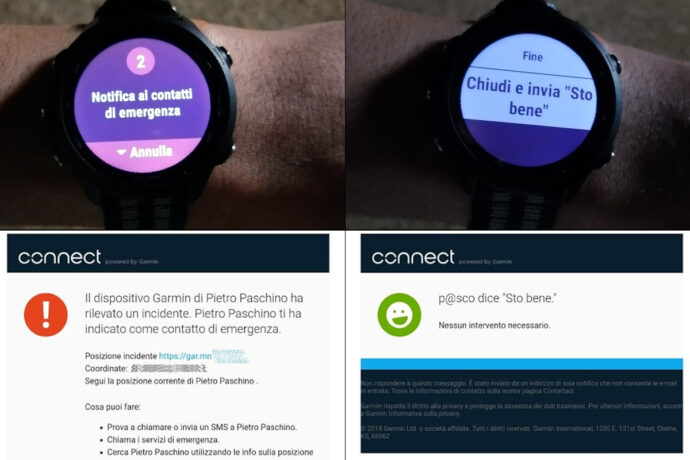
Two small (but not so much) bonuses of the Forerunner 245: the battery life is amazing. I have it on my wrist 24h/24, taking it off only to wash it after workouts, and I do about an hour of GPS-tracked running on it a day (a little more or a little less) and the battery lasts without major problems for at least 6 days, and if days happen when I need to turn off notifications-which otherwise would always be on-it even goes up to a full week. The second bonus is that there is the ability to automatically report an accident that happened to us during a run. If you stop abruptly while running, in fact, it triggers the system to send the incident report to the phone number and email we have designated as the emergency contact, which receives the coordinates where you are at that moment. It is, of course, possible to cancel the submission (there are 15 seconds before the report starts) or even to send an automatic message to inform the person contacted that it was an error. The only downside to this system is that in order to use it you have to have your phone connected to the watch and field with you in order to send the alert, but it is still a very good implementation, in my opinion.
Why switch to 245 from Fenix 3 then? Because I’m basically a geek, I like data and statistics, and I was interested in the idea of knowing a few more metrics than my “old” Fenix 3 could give me; because aesthetically the difference is there but it’s not that excessive (I don’t know if I would put on a smartband, for example); because it’s true, I do other sports activities from time to time, but for those that aren’t supported by the 245 I can always wear the Fenix 3 again and record them with that. Or simply do not record them.
Well, I’d say that’s enough for this time, I hope I didn’t bore you too much!
The 245 can be purchased from the Garmin page
here
in the basic version (the one I have) and
here
in the Music version, with 3.5 gb of space to upload your mp3s and wifi connection.