
Onpersonal preferences on the subject of “vacation destination” one could, unnecessarily, argue for hours. The age-old sea vs. mountain issue-although I am a big supporter of the latter-has always left me lukewarm, almost bored: it’s not a matter of bringing valid arguments; if you like yellow, it’s not like I can convince you that blue is better.
But today I want to go a little bit further. What motivates someone to use a large part of his vacation days to do something that-needless to deny it-will be extremely tiring and that will eventually then make him say, “I need vacation now”?
Of course, loving nature is clearly the first step. And I mean to love it as it is: without the cable car to get to the top, without the chiringuito with mojitos and umbrellas (however, all three are always praised: chiringuito, mojito and umbrellas). If you are not familiar with The Clean Outdoor Manifesto take a couple of minutes to fill in that gap.

The first time I approached a high route my thought was something like, let’s try it, it’s 4-5 days and then I’ll have a real vacation. Four days and a huge portion of pizzoccheri later I knew there was no truer vacation than that.
Okay, let’s take a little step back. What is a high way? Simplifying, we can say that it is a hiking trail that combines other existing trails into a single trail. So basically it is a long route , to be done in several days/taps taking advantage of existing shelters or bivouacs. You tend to stay mostly at altitude (hence the name) but a lot depends on the route you choose. If you are particularly well-performing and adventure-loving, you can also bring along a tent (and a sleeping bag; and a sleeping pad; and a small stove; and some food to cook) but this will have a major impact on the weight of your backpack: more on that later. But if you ask me what a high way is, I will tell you that it is first and foremost an experience of life, introspection and sharing.
How to choose a high way
Ah. Good question this. The first variable is definitely the time you have available, but keep in mind that you don’t have to do it all, it’s permissible to do just a little bit of it, as is often done with the Camino de Santiago: which I like to jokingly describe as a high route but with no elevation gain and in flip-flops.
Then there is the purely logistical issue. Unless you choose a (very rare) high loop route the routes are almost always point to point and you will have to arrange to leave a means of transportation on arrival and then hitchhike or bus to the start. Of course, you can also leave the car at the start and take the bus at the end, but I would advise against it because on the last day of the walk you will want some certainty and not spend the last few kilometers thinking “who knows if the bus will pass today that it’s Sunday, too” or miss it because – the unexpected is always around the corner – you arrived too late. Neither of these two examples was mentioned casually.
Finally there is the non-trivial issue of difficulty: like any trail a high route can be tourist (T), hiking (E), for experienced hikers (EE) or with equipped sections (EEA). The most likely thing is to encounter a mix of these types, which is why it is important to study the route well, know what you are getting into, and go in prepared.
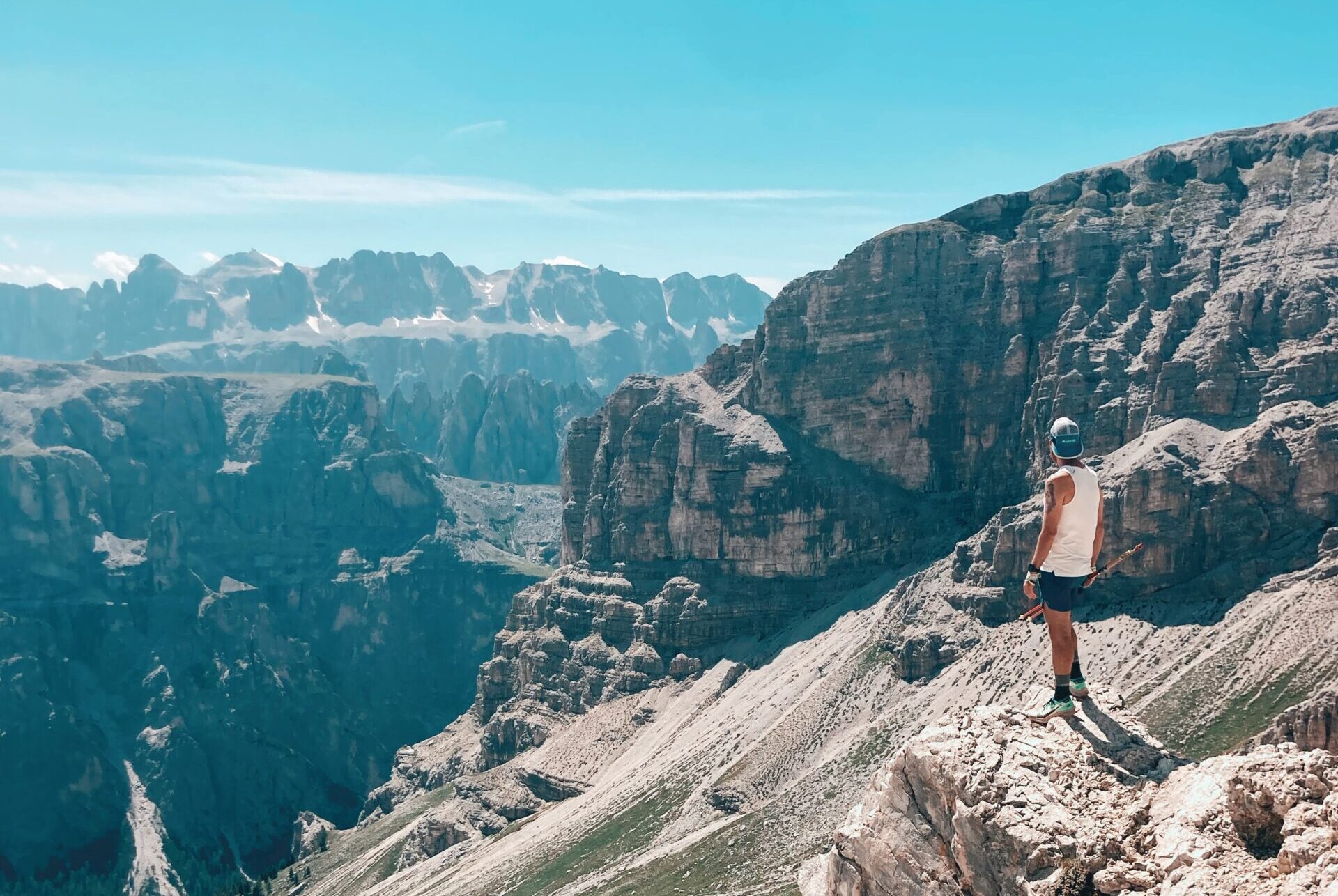
R and I had 7-8 days to spare this year and chose to walk about 2/3 of the Dolomite Alta Via 2, from Bressanone to Passo Rolle. This way, moreover, we would have closed just before the stretches for which additional equipment would be needed began: not that it was a technical obstacle for us, but no one likes to carry an unused harness and via ferrata kit in their backpack for eight days. Also because backpacking was a very hot topic for us this year.
Prepare the backpack
It opens Pandora’s box here, I know. I have learned over the years to reduce more and more what is necessary, doing trail running then I know how crucial it is to balance weight and content. Last year for the Tour du Mont Blanc we filled about 35 liters of backpack, but we both knew we could do better. So the goal was to fit in a 27-liter backpack, which besides obviously meaning less weight, meant having a more compact and lighter backpack of its own.
What did I put in it? This part is my pride, so here’s a scattered list of the content, which obviously includes what you wear at the start, to be read strictly in this tone.
- A pair of hiking shoes. We knew there would be long stretches of what I call mountain highways, flat trails that are not at all technical: you have to know the route and make the right choice between technical and comfortable footwear. I used the most comfortable trail shoes I have and-despite the laughter and dubious looks of many from the heights of their knee-high boots-I would make this choice a hundred more times.
- A pair of replacement insoles. Needless to bring a second pair of shoes, heavy and bulky, but if you get a downpour one day you’ll be thankful you have dry insoles to replace.
- Three technical T-shirts, at least one of which is very garish: for mere outfit issues. Forecast in hand this year, I decided to opt for two T-shirts and a tank top.
- Two pairs of technical shorts + one long pant (also technical). Except in very rare cases I always prefer the short sock: if it rains a lot you get wet anyway, and the short one dries in no time.
- A thermal wool sweater.
- Three pairs of medium/high technical socks (yes, in the woods it is full of brambles and occasionally even ticks).
- Two pairs of underwear. Ok some very personal issues open up here but I would like to clarify that my shorts have integrated briefs so my need was related exclusively to the evening in the shelter post-shower.
- Stack.
- A cap (not a fisherman’s cap, don’t be ridiculous).
- A pair of sunglasses.
- My inseparable Victorinox utility knife that I have had since I was 13 years old.
- Sunscreen. Toothbrush. Toothpaste. Painkillers. Bandage for any bandages.
- Rain shell.
- Thermal cover.
- Compressible down jacket (never used this year, but better to always have it with you).
- Synthetic towel (the terry cloth one, besides being heavy and bulky, would stay wet and smelly throughout the trip).
- Marseille soap: for yourself and your clothes. That’s right, reducing clothing to the bone means washing it daily, which is why I almost exclusively had technical garments that dried in a very short time.
- Slippers.
- Sleeping bag (mandatory in shelters).
- Gloves.
- Water bottle.
- Paper map, yes, I am nostalgic.
- Neckwarmer.
- Trekking poles.
- Battery charger. Front stack.
- Two sandwiches. Two cans of tuna. Three hard-boiled eggs.
- Gummy candy.

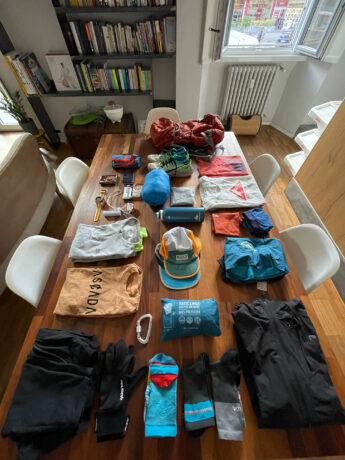
Total weight (excluding minimum worn) 6 kg, for eight days and seven nights. And I can tell you that this choice of minimizing really made a difference, especially in the stages above 5-6 hours of walking. Along the way, we met many hikers doing the same route as us-this is one of the first nice things about a high route: after a couple of days you find fellow hikers, with whom you may not share the day on the trail, but you certainly meet in the evening at the hut-and I can’t help but look at others’ backpacks and clothing to see where to improve (there is always someone who knows better than you).
In short there was this couple, just remembering makes me tired, to walk the same high route as us both had 60-liter backpacks full to bursting. On the fourth day, I couldn’t resist and asked them how much they weighed: when they answered 22 kg, I squinted my eyes and understood why they arrived at the end of each stage 3-4 hours after us. I want to hope it was 22 kg of speck.
Sleep (and eat)
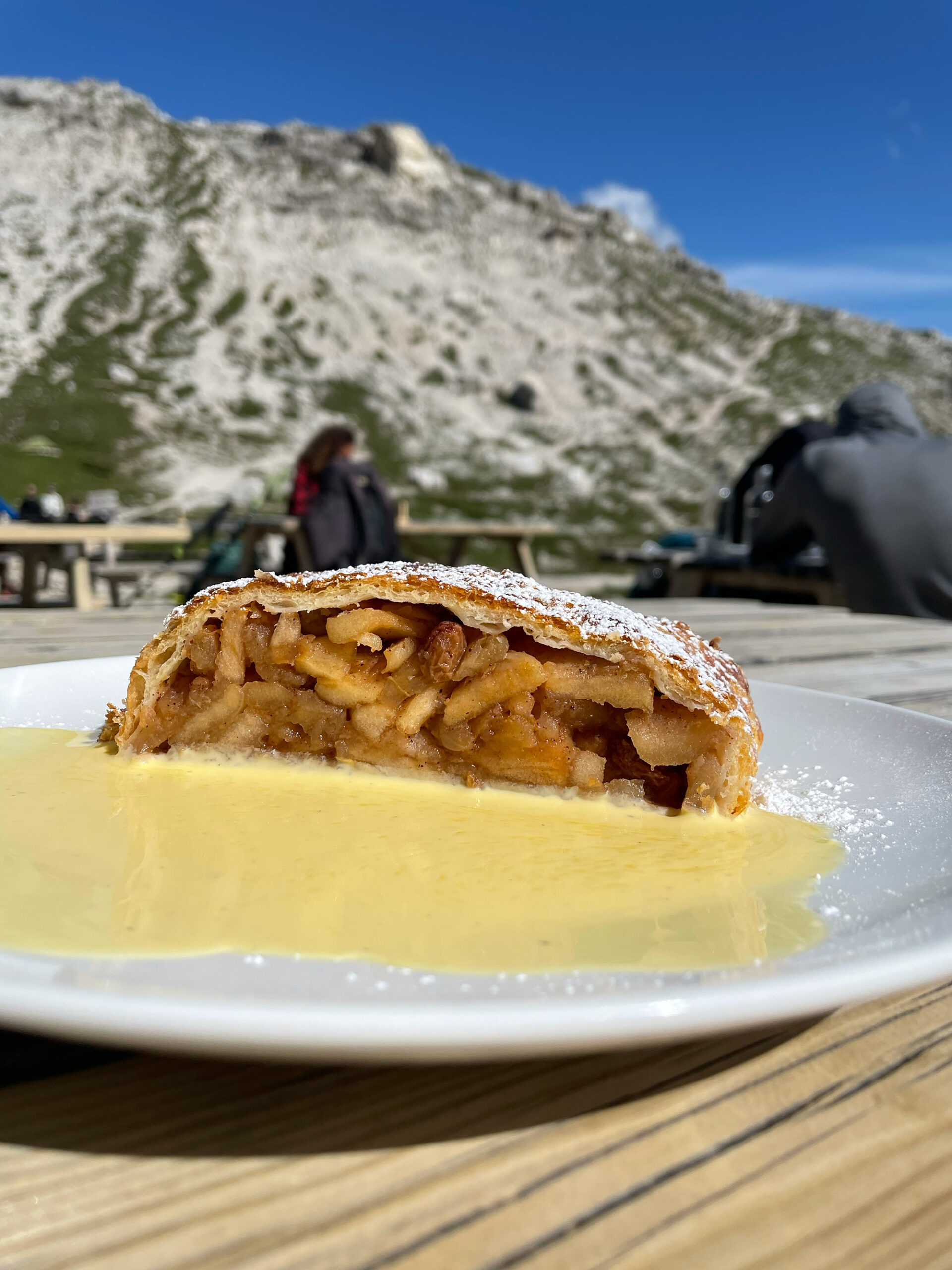
Excluding the tent option, people sleep in shelters. A mountain hut is a place that fills your heart and belly: it welcomes you, warms you, refreshes you. But a shelter is not-thank goodness-a hotel. If there is water (yes, I said IF) it may not necessarily be hot; in the event, you are still likely to have to pay through the nose for a few minutes of shower time. You sleep in dormitories: if you are lucky 4-6 places, if you are bad 18-20 places. Bunk beds of course, even three-story beds. Uncomfortable? It can be. But dinner is served at 6:30 p.m. anyway, and in the worst (best?) case scenario at 9 p.m. you will have already collapsed in your bunk, tired but happy.
Alta Via 2 of the Dolomites
The route is nothing short of enchanting. The Dolomites give you sunsets that you won’t see anywhere else in the world, and the high routes in these regions are so heterogeneous that every day you cross ever-changing mountain ranges and the landscape is constantly changing (unlike, for example, the high routes in the Aosta Valley, where the stages are much more homogeneous with each other).
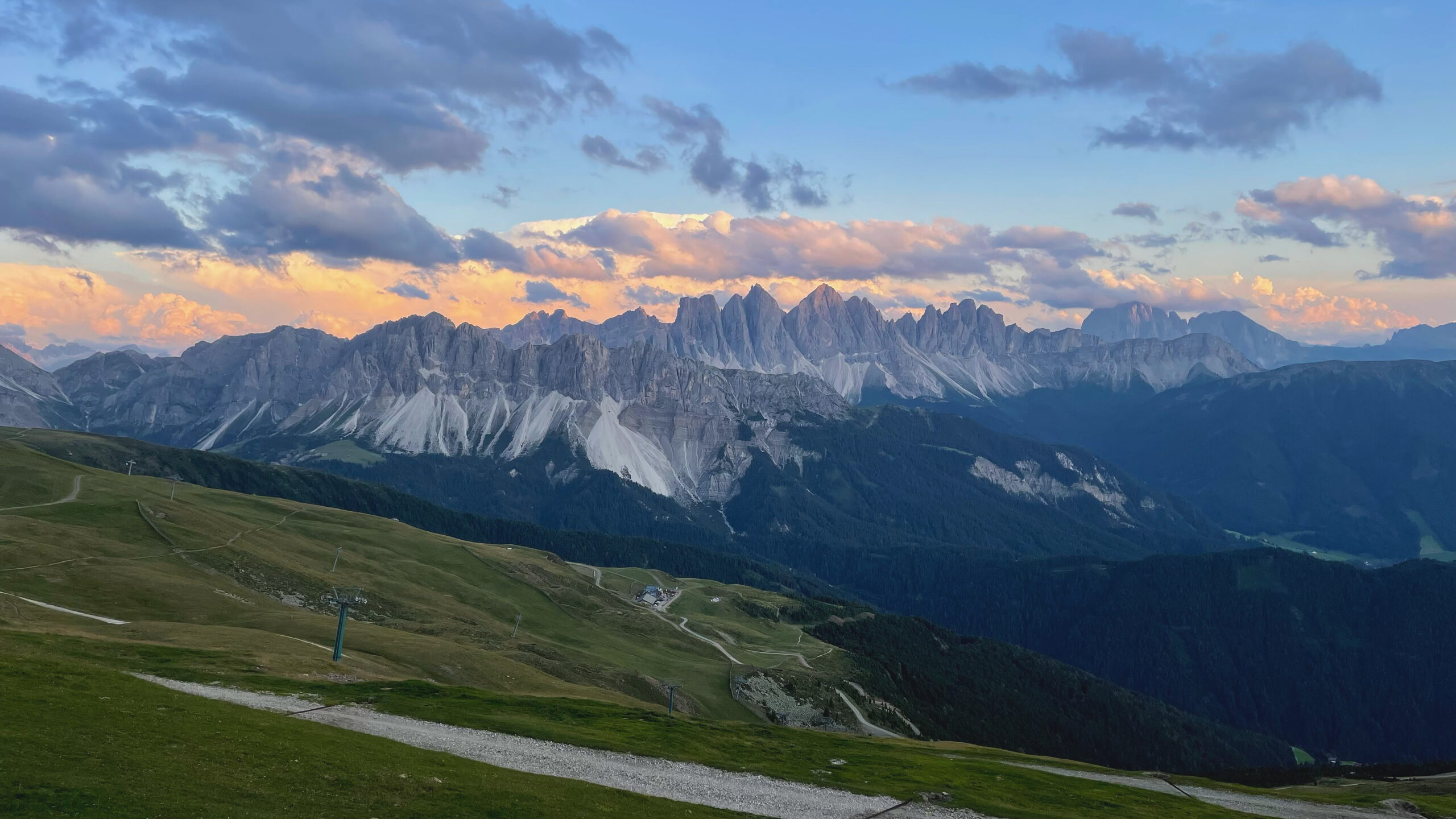
We crossed the Plose group, the Puez-Odle, the Sella (with a detour to the summit of Piz Boè, which once you go under it would be a crime not to climb), the Marmolada and the Pale di San Martino. A detailed description of each stage would not do them justice, but know that it was 96 kilometers and 6,000 D+ of pure ecstasy for the eyes and the heart (and for the belly, in a couple of shelters I would go back even just for the food). If you have five minutes to spare here you will find a brief visual account.
I can only recommend such an experience, carefully choosing the right path is something within anyone’s reach. What I feel like repeating to boredom, however, is: study, inform and plan. If you have the tent you will be freer, vice versa you will naturally be bound by the need to have a roof to shelter under and thus to structure more defined stages. Despite careful planning we got a 32-kilometer stage with a grueling fork, 2,000 meters of elevation gain and more than 10 hours of walking. R didn’t slit my throat in his sleep but I can guarantee he would have wanted to.
But so we finally figured out what makes you do it? You do it, then you tell me. I meanwhile choose next year’s high road.