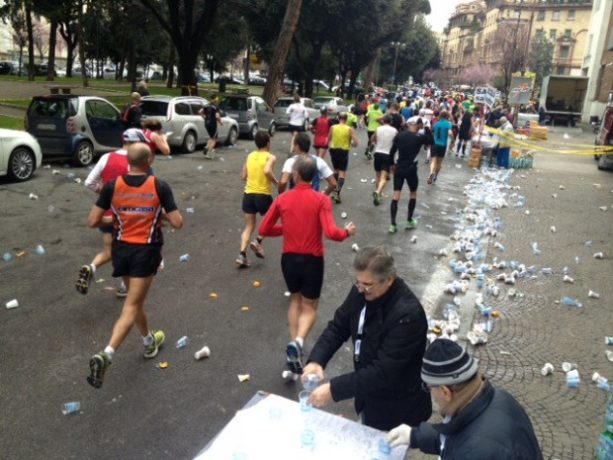
We are always led to believe that the greatest revolutions have to do with the latest technology, microchips and computers. Balls.
One of the greatest revolutions of the modern era in ultrarunning has been the invention, or more accurately, the realization of the idea of being self-sufficient while out running.
Does this sound obvious? Not if we think that in essence this conception exists only in ultrarunning among the disciplines of running.
If you remember the pioneers of running, which we discussed in a previous article, you will understand that rather than the result of an intuition the whole thing developed over time because of a real need. To wit:
– try not to die dehydrated
– Increase one’s performance by being able to avoid dehydration
– try not to die dehydrated

Long-distance running maximizes what are the basic needs of a person. On a 20-minute run in the spring, in the cool weather, you don’t really need to drink.
Things already change if you run an hour or two.
Things are very different if you run 24 or 30 hours, maybe in the middle of summer, maybe in desert areas, but also just in a very sunny area. There drinking becomes a very important thing and can often be the borderline between coming out on top or not in a race.
Assuming that there is no need to explain the superfluity of disposable cups or plastic half-liter water bottles as is the case in road races, and that I strongly hope that this absurd and environmentally harmful practice will be repudiated by all runners, let’s say that the idea of aid station (or refreshment station) has also always been prevalent in the modern ultrarunning community, with the idea of a “water point” where one can refresh oneself. Sort of like encountering a drinking fountain or a stream in a mountainous path.
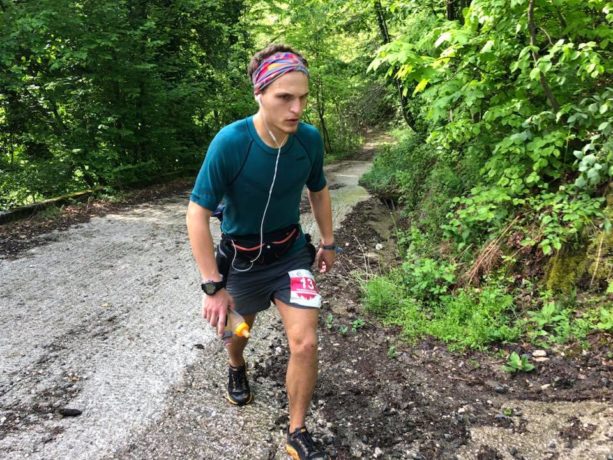
And what is the easiest and most effective method than running with a water bottle in hand?
– fills up immediately
– is great for taking short sips while you keep running (unlike bottles with caps)
– water more or less tastes like water (and not like a plastic tube that you heat up as in camelback)
– I have never had it freeze in the cold (unlike the camelback tube)
So whether it’s fabric supports, silicone, or simply two rubber bands to keep the water bottle attached to the hand, the biggest evolution was of thought, namely self-sufficiency. The realization that even moving fast, over any terrain, you have to think for yourself, and not die dehydrated is the first big rule for those who want to try the sacred distances of ultrarunning.
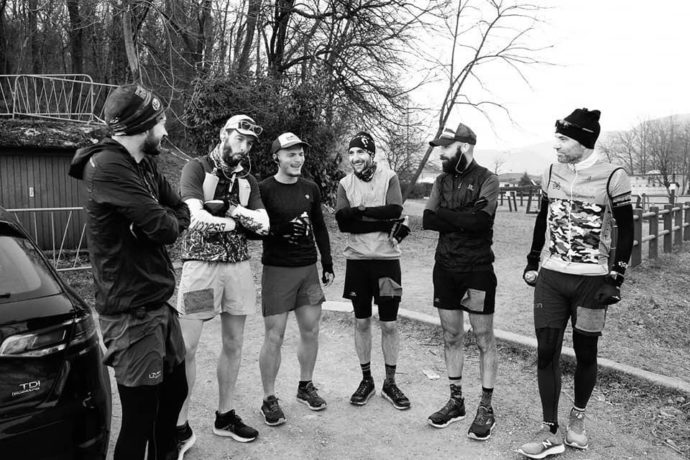
Do you prefer the backpack with the water bag?
Okay! and what’s the problem? everyone has their own taste.
The important thing is to cut down on plastic and the practice of disposability. In life and in running.