
There is one detail about some models of running shoes that you may not have missed: for the past few years there have been some without rubber panels on the sole. Exactly: what is so called in common parlance, that is, the part in direct contact with the surface on which you run (road, dirt, grass, whatever) has disappeared to make way for the midsole, which, in that region of the shoe, is sculpted to provide grip but without employing different materials.
There had been a foretaste of this trend back in 2016 with the Nike Vaporfly Next% with which Eliud Kipchoge first attempted to run the marathon distance in less than two hours in Monza: in that case only the midfoot/heel portion was devoid of any wear layer while the forefoot (the one most stressed during the run) was covered with a rubber panel.
The reason
The main reason why some brands have eliminated this component of the shoe (solving it in other ways anyway) is weight containment: the fewer components that make up the shoe, the less material there is and therefore the less weight. There is also another one and that is that, for those who have run in them, these types of shoes guarantee a different and much lighter, ground-contact experience.
As mentioned above, the absence of rubber does not mean that the surface in contact with the road is not less grippy: the sculptures that provide grip still exist.
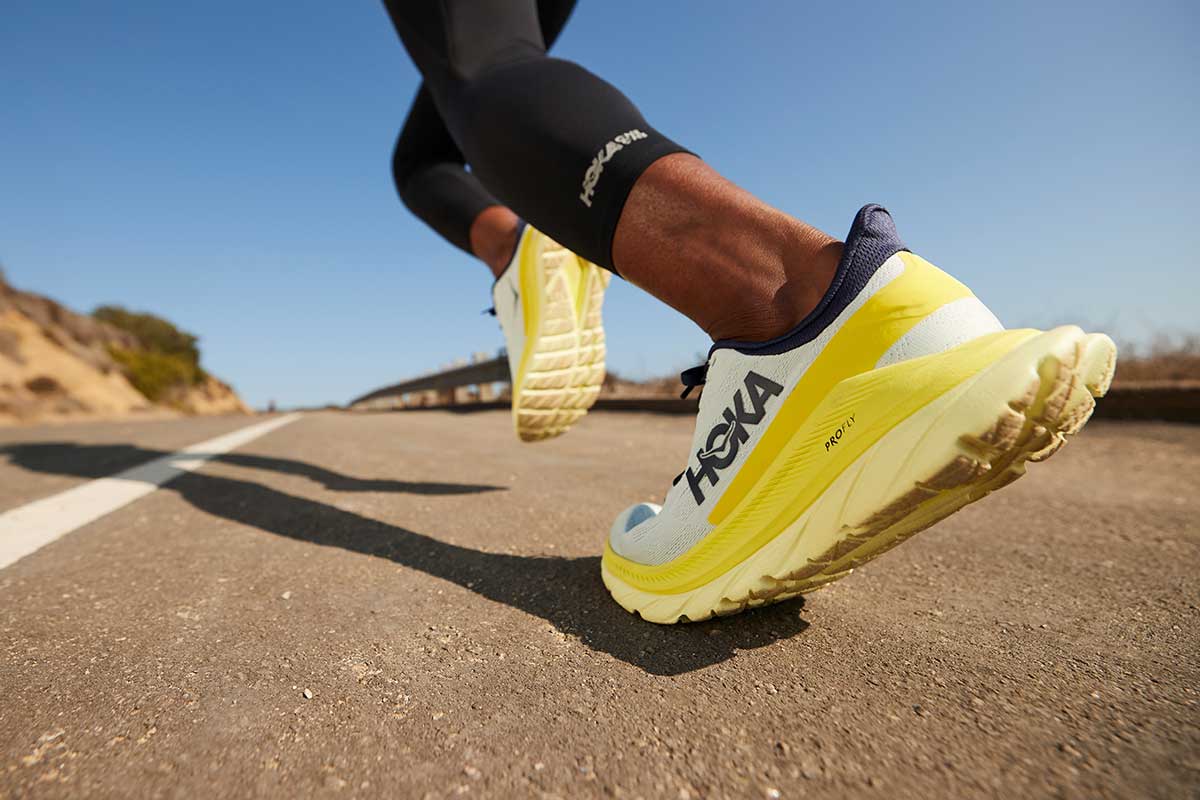
Another example of a shoe with a peculiar tread that might suggest it is entirely without rubber is the Hoka Mach 4, which actually offers an interesting solution with rubberized EVA: as in, “reinforced” in the part in contact with the ground. In the group of shoes with very little rubber then we can’t fail to mention the adidas Adizero Adios Pro 2.0: they have so little of it that it almost looks like abrasive tape applied in the minimum possible thickness and that’s it.
Those who are going down this road

Instead, those who went “all in”-as they say, meaning “full midsole”-is Under Armour, which with the Flow Velociti Wind 2 (not yet available in the Italian market) proposes a shoe made of two parts and that’s it: upper and midsole (which is also sole, needless to say).
The tread pattern in this case is achieved with a very complex weave that is definitely fascinating to see: it looks like a fabric with embossed elements. The purpose is obviously not aesthetic but practical and that is to provide grip.
Those who have raced there-namely, the elite athletes who help Under Armour develop its products-agree that it is a different experience than usual.
If then the fear that may come is that they are shoes more prone to wear and tear since their midsole is “exposed,” Under Armour guarantees that the contact part is obviously reinforced and super-durable.
A new direction?
Among the many innovations seen in the running world, this is one of the most original: it does not involve materials or particular mechanical solutions but goes down a path that tends toward the most extreme simplification of the shoe system: very few components and just as few materials. To get to shoehorn the minimum necessary to give the maximum.