
Tired of your same old yoga mat routine? AcroYoga literally gets you off the ground — and forces you to trust: it’s a full-body (and relationship) workout.
- AcroYoga blends the wisdom of yoga, the energy of acrobatics, and the kindness of Thai massage into a practice done in pairs or small groups.
- It’s not just about strength and balance — it’s a powerful tool for building trust, improving communication, and creating real connection with your partner.
- There are three key roles: the Base (on the ground, providing stability), the Flyer (the one in the air), and the Spotter (your “safety net”).
- Verbal and non-verbal communication is everything: you need to clearly express your intentions and read your partner’s cues to practice safely.
- Start with beginner-friendly and safe poses like the Throne, Front Bird, and Whale: they’re your trust-training gym.
- This practice is a metaphor for relationships: learning to support and be supported, to fall and rise — together — with intention and playfulness.
The Yoga That Teaches You to Fly (and Trust)
Let’s be honest: sometimes your yoga mat feels like a tiny island of blissful — yet lonely — introspection. You retreat into yourself, search for inner balance, and your only companion is your neighbor’s heavy breathing in Warrior Pose. Very zen, sure. But there’s another way to break out of the solitude and turn your practice into a shared flight. Think part circus act, part group therapy. Sounds weird? Stick with us.
We’re talking about AcroYoga. If you’ve always thought acrobatics were just for circus performers and yoga was all serious business, AcroYoga comes along with the kind of playful irony that doesn’t take itself too seriously. It’s not just a physical discipline — it’s training ground for balance, strength, and most importantly, trust. It’s also a fast way to find out if your partner’s got your back or if they’ll let you crash and burn at the first sign of instability.
What Is AcroYoga — and Why It’s a Powerful Relationship Metaphor
AcroYoga is exactly what it sounds like: a blend of three seemingly unrelated worlds. You’ve got the wisdom of yoga (breathwork, awareness), the dynamic movement of acrobatics (flight, motion, challenge), and, surprisingly, the art of Thai massage (therapeutic and relaxing, typically saved for the end).
The big difference from traditional yoga — the kind where you wrestle solo with your leg — is that this is done in pairs or small groups. And that’s where the magic happens, because the real benefits aren’t just physical (though you will discover muscles you didn’t know you had). The real bonus is the human connection.
You can’t fake it in AcroYoga: you’re forced to communicate and fully trust another person. If you’re the Base (more on that in a moment), you need to trust your strength and your ability to support. If you’re the Flyer, you have to trust — completely — that the other person won’t let you fall. It’s a beautiful relationship metaphor: learning to hold and be held, to feel light yet grounded, and to understand that falling isn’t failing — it’s valuable feedback on how to rise again, together.
The Roles: Base, Flyer, and Spotter
To avoid turning your session into an episode of Takeshi’s Castle, AcroYoga follows clear and crucial roles. No winging it allowed.
- The Base: The one on the ground. Typically the more stable and strong person. The Base is your safety mat — your foundation — using hands and feet (mainly pivoting from the hips) to lift and support the Flyer. The key is staying in constant contact with the floor, with arms and legs locked and aligned to create a solid platform.
- The Flyer: The one who takes flight. The Flyer moves, balances, and — in many ways — surrenders. They need to be light and engaged, but more importantly, they have to know how to let go of tension and clearly communicate their weight and intentions to the Base.
- The Spotter (aka human “safety net”): The silent superhero — and for beginners, the most important role. The Spotter stands nearby, and their sole mission is safety. They don’t perform the move but are there to prevent falls and offer helpful balance cues, especially near the Flyer’s head and shoulders. Never skip the Spotter when you’re starting out.
3 Beginner-Friendly Poses to Start Playing
If you’re new to all this, we strongly suggest skipping the “Tower of Human Doom” you saw on Instagram. The name isn’t exactly reassuring — and no, no one’s died. At least not yet. (Kidding. Seriously.)
Start slow. Build your foundation. Remember: communication is everything. Before you move, say what you’re about to do and make sure your partner hears and understands you.
The Throne Pose (Throne Pose)
Perfect for getting comfortable. The Base sits with knees bent and feet on the floor. The Flyer sits on the Base’s feet like a tiny throne (hence the name), while holding hands. The Base then slowly extends their legs, lifting the Flyer who stays seated midair. Simple, safe, and a great way to feel each other’s weight.
Front Bird (Front Bird)
This is AcroYoga’s signature pose — your flight initiation.
- Base: Lie on your back, knees bent at 90 degrees. Your feet are the Flyer’s launchpads.
- Flyer: Stand facing the Base, give a small jump. The Base places the Flyer’s hands on their shoulders and feet on the Flyer’s hips (near the hip bones).
- The Flight: The Base extends their legs to push the Flyer upward. The Flyer stretches into a straight line — arms wide, gaze forward. The key is for both Flyer and Base to press into each other, creating a compression balance.
Whale Pose (Whale Pose)
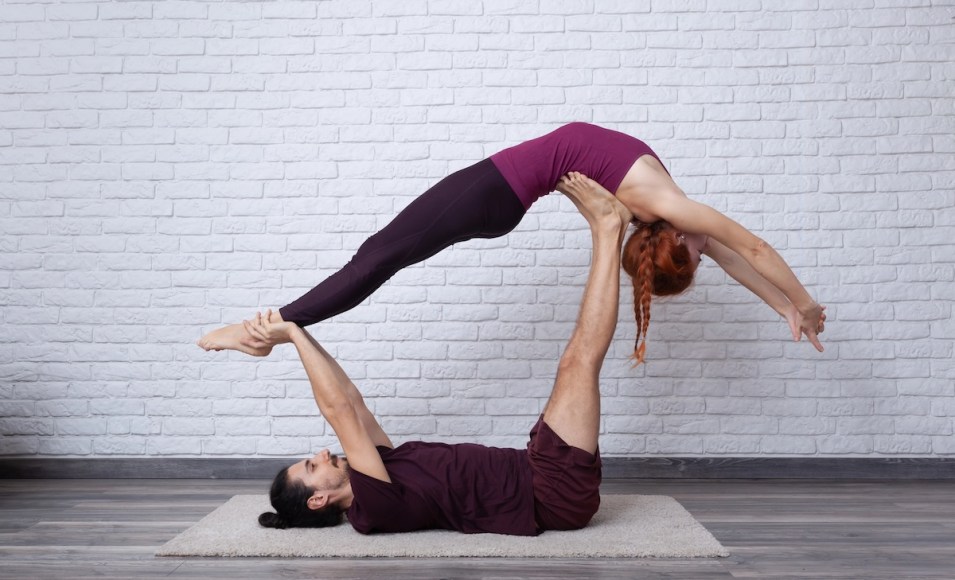
A more relaxing pose, often used as a transition or therapeutic hold. The Base is in a similar setup to Front Bird, but Whale Pose is usually a gentle backbend for the Flyer. The Base’s feet support the Flyer’s lower back, and the Flyer surrenders into a soft arc — like lying in a floating hammock. It’s the first step toward letting go of control and enjoying the massage.
How to Find an AcroYoga Community Near You
Unlike running — where all you need is a pair of shoes and a front door — AcroYoga requires other people (and ideally, a trained instructor to start). Don’t go full Bruce Lee of yoga in your living room solo.
The best way to begin is to search for beginner AcroYoga classes or workshops in your area. These practices often spread by word of mouth and gather in parks where the vibe is welcoming and no one cares how experienced you are. Google or search on social platforms using terms like “AcroYoga [Your City]” or “AcroYoga Jam Session.” You’ll quickly see how playful and inclusive the scene is. You don’t need to bring a partner — in fact, switching Bases and Flyers is part of the philosophy, helping everyone adapt to different weights and strengths.
You’ll find yourself falling and laughing, supporting and being supported — and you’ll soon realize real strength isn’t about lifting weight, but about building bonds that don’t fall apart with the first gust of wind.