Brooks launches the Glycerin Max 2, taking cushioning to 45mm with a new midsole and geometry designed for fluidity.
- Brooks has introduced the Glycerin Max 2, an evolution of its most cushioned shoe ever (until now).
- The goal is maximum comfort and protection over long distances.
- The midsole is the new nitrogen-infused DNA Tuned, featuring a dual-cell structure
- The different cell densities (soft in the heel, responsive in the toe) balance impact and propulsion
- The stack height is significant: 45 mm in the heel and 39 mm in the forefoot (6 mm drop).
- The GlideRoll Rocker technology facilitates transition and a fluid roll-through.
Comfort Is a Serious Thing. In Fact, “Max.”
We live in a fascinating time for running: while just a few years ago the discussion was all about minimalism and “natural running,” today the dominant trend is clear: maximalism. We want to run as comfortably as possible and with plenty of cushioning.
The point, however, is that just stacking centimeters of compound under the foot isn’t enough to make a good shoe. In fact, the opposite is often true: the taller and softer a shoe is, the more it risks being unstable, heavy, or simply unresponsive, ending up absorbing all the energy you produce without returning anything.
Brooks, which has long championed the philosophy of “comfort” (the Glycerin line has been a pillar for many years), has decided to raise the stakes. After the first version, the new Glycerin Max 2 arrives, and the name says it all. This isn’t just about comfort, but maximum comfort.
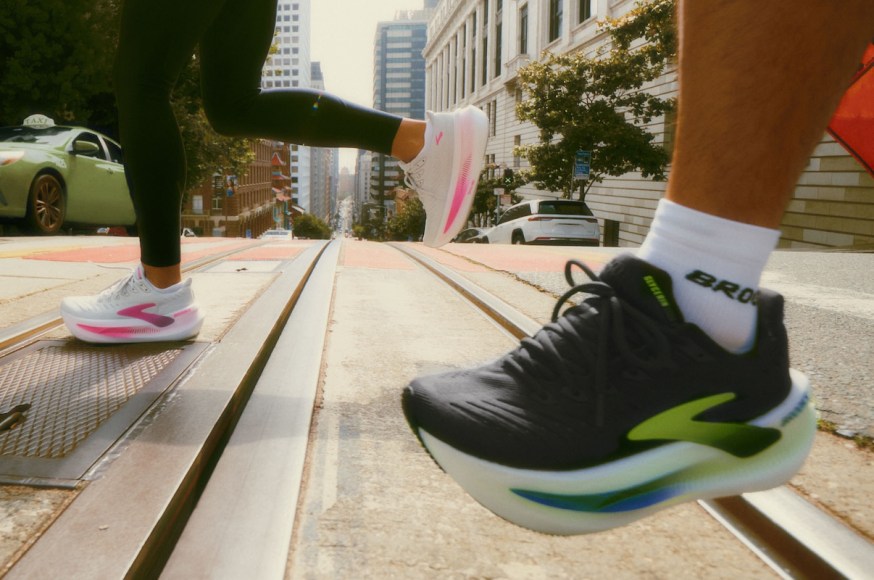
45 Millimeters of Softness
Let’s start with the stat everyone wants to know: the height. The Glycerin Max 2 features a stack of 45 mm in the heel and 39 mm in the forefoot. We are at the limits (literally, in the case of official competitions, although this isn’t a race-day shoe) of what you can put under a foot.
But, as we said, height isn’t everything. What matters is what’s inside those 45 millimeters. Brooks introduces a new midsole called DNA Tuned. It’s a nitrogen-infused compound (a technology Brooks often uses to achieve lightness and responsiveness), but the real innovation lies in its “dual-cell structure.”
What does that mean? Basically, the midsole isn’t a monolithic block with a single density. Brooks has differentiated the structure: larger, softer cells in the heel, to absorb impact in a controlled way, and more compact, responsive cells in the forefoot, to offer a more energetic push-off. It’s a way to give you the best of both worlds: the soft landing you want and the response you need to avoid feeling “stuck in the mud.”
Geometry and Transitions: How to Move a Colossus
Having a midsole like this is useless if the shoe doesn’t move with you. That’s why Brooks worked hard on the geometry. The key technology is called the GlideRoll Rocker, which translates to the “rocking chair” shape of the sole. This pronounced curvature helps the foot roll smoothly from the heel (or midfoot) to the toe, making every step more efficient and less strenuous.
Added to this are “vertical lines” on the sides of the midsole, which Brooks claims further optimize the transition, contributing to a more natural movement.
The Fit: Stability and Space
Finally, the upper. Running on such a high platform requires the foot to be held securely. If the foot moves inside the shoe, instability is guaranteed.
The Glycerin Max 2 uses a triple jacquard Air Mesh (which basically means breathable and structured). But the most important update is the shape: Brooks claims a more snug fit in the midfoot (to keep you locked in place) and, at the same time, more space in the forefoot. This last detail is crucial for long distances: when your feet start to swell after many kilometers, having room for your toes becomes a welcome feature.
The price? 200 €. That’s the cost of running on what Brooks calls the “maximum expression of softness and fluidity” in its collection. A shoe designed not for a 10K PR, but for logging mile after mile in absolute comfort, or for those recovery days when your legs are just asking to be treated well.