
After a week of photos showing worn-down outsoles, we reached out to adidas, and the company sent us an official statement
- The full statement adidas sent us, word for word.
- None of the three technical questions we asked got an answer.
- How that response is built, sentence by sentence, and what it leaves out.
- What the reports of exposed forefoot foam show, and after how many miles.
- The case of the chunk missing from the sidewall, and why it should be kept separate from the rest.
- The switch from ENERGYRODS to ENERGYRIM, the launch numbers, and a BOX with four checks to run on your own pair.
The Adizero Adios Pro 5 went on sale September 22, and within a week it had picked up two stories. The first is the one the brand wanted to tell: the technology that carried Sabastian Sawe under two hours in the marathon trickles down from the Evo 3 (€500) to the mainline race shoe, at €260 in Italy ($275 in the US). The second started almost immediately, as photos of midsoles worn down after just a few runs began circulating on social media.
Over the past few days we put three technical questions to adidas about those photos, and the company sent us an official statement. You’ll find it below, in full, and it’s the first direct document in this story. We’ll give you the key point up front, because it’s what matters if you’re deciding whether to race in this shoe three weeks from now: the statement doesn’t answer the three questions we asked. It gives the brand’s point of view — an entirely legitimate position to take.
Still, it’s worth starting with how this shoe is built. Without that, the discussion stays a matter of photos versus statements, with all the pointless polarization and bickering that follows — none of which interests us.
From Rods to Rim: What Changes Underfoot
Ever since the first Adios Pro, adidas’s carbon has taken the form of ENERGYRODS: thin rods that follow the metatarsal bones, an alternative (one we liked a lot) to the single plate used in most race shoes. The Pro 5 drops them. In their place is ENERGYRIM, a ring-shaped carbon structure that runs along the midsole and is visible from the outside, with a reflective detail at the heel.
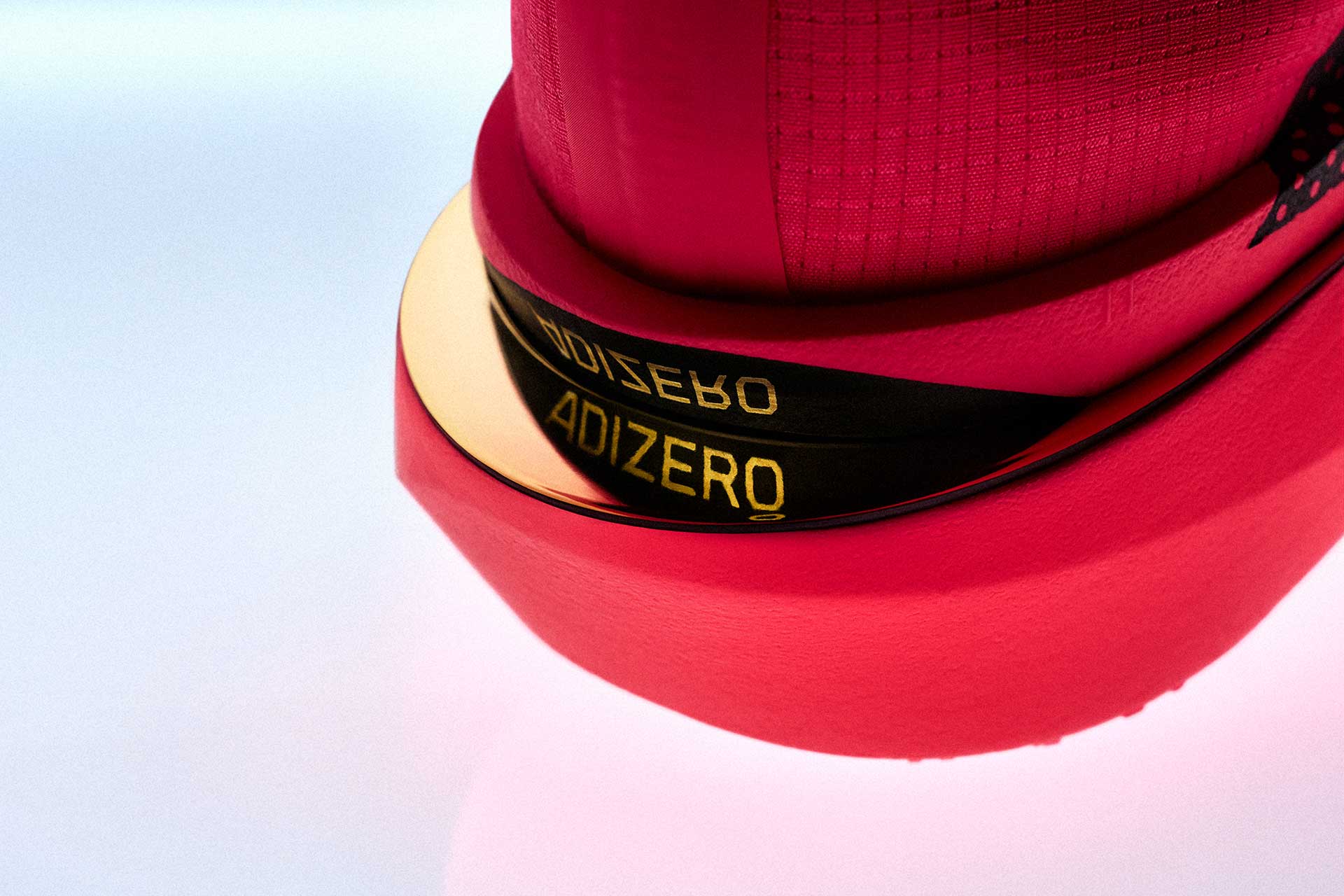
Think of a tennis racket frame. All the stiffness sits in the rim, and that’s exactly what leaves room in the middle for the strings, the part that does the work when you hit the ball. ENERGYRIM follows the same logic: moving the carbon out toward the perimeter frees up volume for LIGHTSTRIKE PRO foam directly underfoot. adidas describes the structure’s stiffness as tuned to deliver stability and consistent propulsion with every stride.
It’s the most interesting decision in the whole shoe, more than the weight and more than the energy-return figures. In recent years the conversation around fast shoes has shifted, because research credits the foam, more than the plate, with most of the advantage, while the carbon’s main job is keeping such a soft, tall material stable. adidas redesigned the carbon around the foam, not the other way around: a direction consistent with what we now know about these shoes, and a genuinely innovative piece of engineering.
There’s a flip side, though, and it bears directly on this week’s debate. More exposed foam means more soft material in contact with the outside world, and foams of this generation are formulated to return energy, not to resist abrasion or long-term wear. It’s no accident that fast shoes and racers have a limited lifespan.
Weight and Energy Return: How to Read the Numbers
The Pro 5 averages 6.2 oz (177 g), 0.8 oz lighter than the Pro 4 — about 12%. That’s roughly what an AA battery weighs: take one off each foot, multiply it by the thousands of strides in a marathon, and it’s a difference you carry all the way to the finish. Lightness you can feel.
The other headline number is 9% more energy return than the previous model, the result of pairing the new generation of LIGHTSTRIKE PRO with the ENERGYRIM frame. It’s worth reading that figure for what it is. Energy return measures how much of the force you put into compressing the midsole comes back to you at toe-off: it’s a material property measured by adidas, and it shouldn’t be mistaken for 9% more speed on the clock. How much of that margin turns into seconds on race day depends on the pace, body weight and running mechanics of whoever’s wearing it.
Up top sits the LIGHTLOCK 2.0 upper, with targeted ventilation zones, internal support bands and a redesigned heel structure. Underneath, the outsole combines LIGHTTRAXION technology with Continental rubber, with partial coverage concentrated in the highest-abrasion zones. That’s the main way a race shoe saves weight, and it means the rest of the contact surface is foam meeting the asphalt directly.
The Durability Question: What’s Wearing Down, and How Much It Matters
Let’s start with a clarification missing from almost every discussion this week: alongside the videos of damaged shoes, there are also runners showing outsoles and midsoles in perfect shape after dozens of miles.
It’s worth knowing, though, where a lot of those pairs came from. adidas sent the Pro 5 to media and creators ahead of launch, and in some cases — probably — invited them to run the Berlin Marathon in it. There’s nothing wrong with that, to be clear. It’s standard practice for any launch, it’s the brand’s call, and it takes nothing away from any individual experience: those pairs simply remain a limited sample. Add to that the fact that a marathon generally isn’t run in shoes fresh out of the box.
We’re not questioning either experience with the Pro 5. Precise context just helps.
If you’ve bought the Pro 5 or are about to, photograph the midsole as soon as it comes out of the box, from underneath and from the side, and look again after the first few runs. It’s the fastest way to get a reference point, because the reports start early: there are videos showing the first problems after about 9 miles (and other similar cases), and even among testers who had the shoe before release, marks on the exposed forefoot LIGHTSTRIKE PRO showed up quickly, while the outsole rubber stayed intact.

The difference between color and material is the one thing you really need to understand, and anyone can grasp it. Losing the surface finish is like paint chipping off a car door: ugly to look at, irrelevant to the sheet metal and to the people inside. Losing foam is the sheet metal itself thinning out, and in a race shoe that means losing millimeters of material exactly where your foot pushes off, with the geometry changing as you run.
The most striking case making the rounds needs a careful read, though, because it says something different from what it seems to. The Shoe In With Cody showed his Pro 5 with a chunk missing from the midsole sidewall, right at the ENERGYRIM, after a long run. The same account includes an important detail: around mile 4 he landed badly and rolled his ankle, then kept going for another 10 miles before stopping. In a twist like that, all your weight lands on the outer edge of a platform just over an inch and a half tall, and that edge is bare foam scraping the asphalt at an angle it was never designed for. An episode like that could plausibly tear away some material, and the miles run afterward, on an already deformed base, may have made the damage worse.
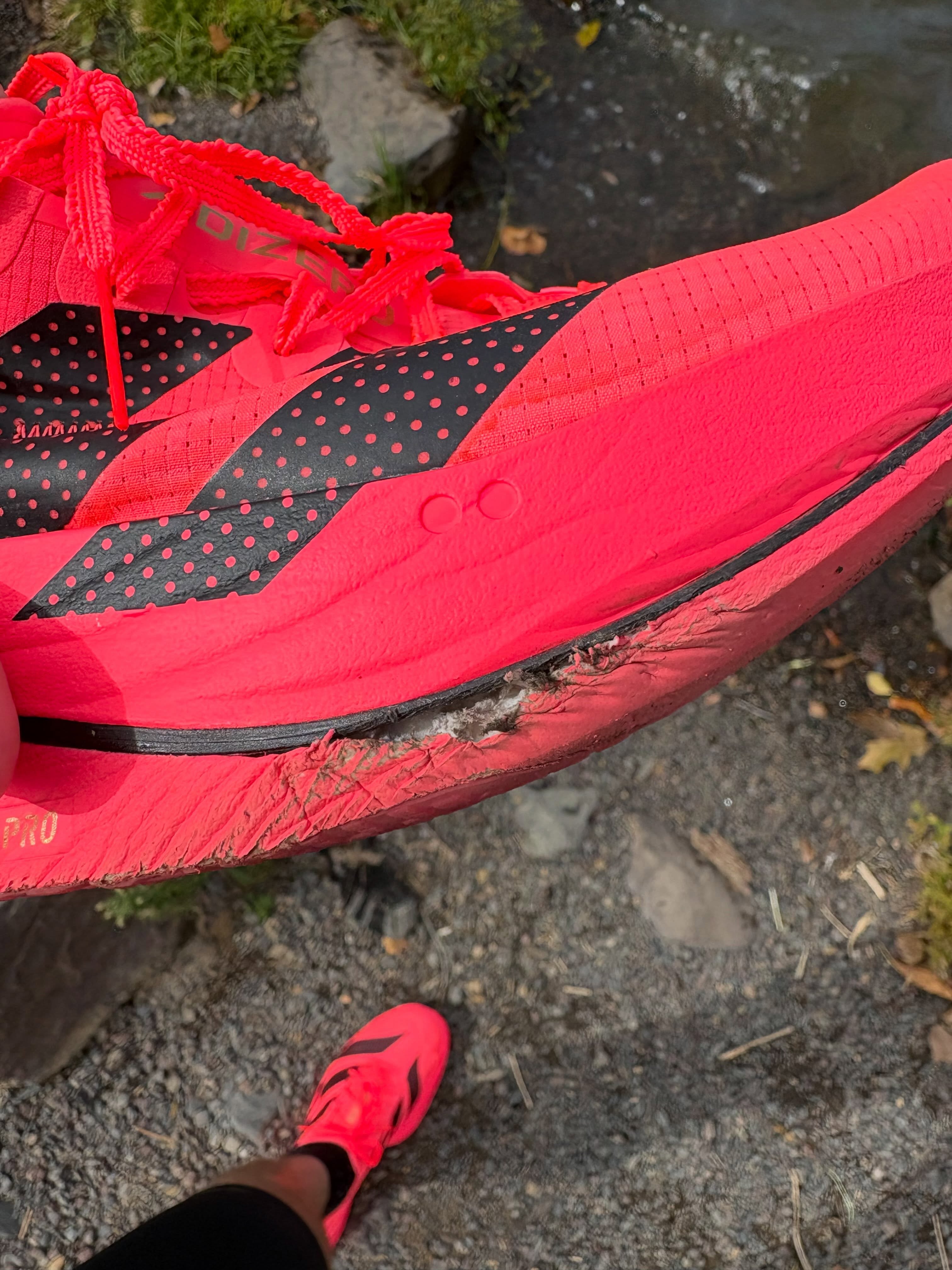
One question remains that that photo can’t answer, and it’s about the order of events. He noticed his ankle, not his shoe. If the chunk of foam had come off first, taking away support on that side, his story would read exactly the same, word for word. Until that sequence is known, the case counts as a report worth watching rather than proof of a construction defect.
Some have also blamed users’ feet for the midsole erosion, urging people not to believe everything they see. We agree with the general line — unusual foot strikes may well play a part, all sorts of things show up on social media, and caution is always warranted — but that position still rests on subjective impressions and hypotheses.
An interesting test, maybe the most interesting of all, came from trc.techno: four pairs of Adios Pro 5 on the feet of four runners at the Berlin Marathon. Two pairs came back in perfect condition, one with the finish worn off and a little foam missing, and one far more damaged. The video’s author attributes that last one to the way he lands on the outside of his foot, and says the damage didn’t affect his run.
So: plenty of hypotheses, some controversy, lots of comments for and lots against. Who better to give a more precise answer than the people who designed and tested the shoe? That’s why we went straight to adidas.
adidas’s Response, Read Closely
We asked the company three questions: how thick the finish layer is on the exposed LIGHTSTRIKE PRO, and how to tell loss of finish from loss of material by eye; what midsole wear adidas considers normal in the first 100 km (about 60 miles); and how well the ENERGYRIM construction tolerates an abnormal lateral landing, and whether similar cases came up in pre-launch testing. The reply came fast but not immediately, because we were told we were the first in Italy to ask. This is the statement we received last night (September 29 at 7:25 p.m. Italian time), reproduced in full and unedited:
“We have seen a small number of runners experiencing cosmetic abrasion on the outsole of the Adizero Adios Pro 5. Based on an initial assessment, this is aesthetic with no impact on performance. If consumers experience any structural issue on the Pro5 then we ask that they return these products to the retailer for our assessment and we will provide free return and exchange support.”
“The Adizero Adios Pro 5 has been extensively tested through its development and received consistently positive feedback. Their durability is on par with our performance running shoes across our range.”
It’s worth pausing here to read the statement calmly and weigh every word — an exercise that goes well beyond this particular case. This is a statement from one of the biggest brands in the sport, and it is, by definition, cautious.
First, adidas says it has seen a small number of cases, and that’s good news. In the same sentence, though, it defines the anomaly as “cosmetic abrasion” on the outsole, most likely the outcome of that first round of evaluation. The next sentence states that this has “no impact on performance.”
They then add that anyone who experiences a structural issue can return the shoe. This isn’t an opening to the idea that some of the reported cases might be structural; it’s simply the procedure that applies to any defective product from any brand, statutory warranty included.
Three details complete the picture. Initial assessment means a preliminary evaluation: nothing definitive has been claimed, so nothing will need retracting if something else comes out tomorrow. Any structural issue is a generic formula that says nothing about the cases reported this week. And the second paragraph contains not a single number: the positive feedback comes from testers the company chose during development, and durability “on par with our performance running shoes across our range” is a relative comparison with no stated benchmark. Race shoes at this level are short-lived by design, so knowing this one lasts as long as its siblings tells you nothing about how long it actually lasts. All the more so because durability varies widely within the Adizero franchise — think of the Adios Pro Evo 3 and the Adizero SL 2, the two extremes.
The upshot is that none of our three questions got an answer. We don’t know how thick the finish layer is or how to tell cosmetic wear from structural damage; we don’t know what wear the company considers normal in the first 100 km; we don’t know how the construction behaves under an abnormal lateral load.
Boiled down, the statement says this: an initial analysis points to cosmetic abrasion, shoes with structural problems will be replaced, and the shoe was extensively tested with positive feedback.
What it leaves out is the midsole sidewall. The statement talks about abrasion on the outsole, meaning the contact surface where LIGHTSTRIKE PRO isn’t covered by rubber, and that’s where the cosmetic explanation is most plausible. About the side — the site of the most striking case to surface so far, and a spot where the foam never touches the asphalt under normal conditions — there isn’t a word.
There is one concrete takeaway, though, and it matters because it comes straight from the brand: if your shoe has structural damage, take it back to the retailer and ask for an assessment. adidas has put in writing that returns and exchanges are on them.
One last call remains, a subjective one that each runner will make alone: whether to spend €260 on a shoe that may show “cosmetic abrasion” after only a few miles. But that’s not what we’re here to discuss.
Four Checks on Your Pro 5
Two minutes, all told. First, the exposed forefoot zone: run a fingertip over it. If the color comes off but the surface stays smooth and continuous, you’re in finish territory. If you feel grooves, ragged edges or a missing chunk, it’s material. Second, the sidewall, to check after every stumble, clipped curb or awkward landing: hold it up to the light, look along the line where the carbon meets the foam and make sure everything looks right. If it doesn’t, stop racing in it. Third, the scale: weigh the shoe the day it arrives, then every 60 miles or so. Paint doesn’t change the weight; lost material does. Fourth, if the damage looks structural, take the shoe and your receipt back to the store and ask for an adidas assessment. Warranty rules depend on where you bought it: in Italy, for example, the legal guarantee covers two years from delivery, and in the first year it’s up to the seller to prove the defect wasn’t there. Walk in with dated photos and the conversation starts from a very different place.
Buy Now or Wait
The Pro 5 is still a race shoe in the full sense, built for runners training for a half or full marathon with a time goal who want record-setting technology for little more than half the price of the Evo 3. On performance, the reason you’d buy it in the first place, none of this week’s reports has produced contrary evidence, and that deserves to be said as plainly as we read the statement.
The open question is durability. If you have a race coming up and want to keep the unknowns to a minimum, you can wait two or three weeks: early adopters are doing the road-testing, and by then the miles will say what today’s statement doesn’t. If you’re already running in it, save it for workouts and race day and leave the easy runs to another shoe, as you should with any racer. If you’re looking for a daily trainer, look elsewhere: €260 worn down on easy miles is money badly spent.
In Italy, the Adizero Adios Pro 5 has been available since September 22 on adidas.it, in the adidas app and at specialty running stores, priced at €260.