
At 7:40 a.m. the specimen leaves its den and covers some thirty-five feet to the kitchen. It stops in front of the coffee machine, waits, turns back, sits down. At nine it opens a glowing rectangle on the table and talks for an hour with other specimens it hasn’t met in months, each one shut inside its own little box. At noon food arrives at the door, carried by a specimen on a bicycle, the only one in the entire scene whose shirt is wet with sweat. In the afternoon the specimen pays a bill, books a doctor’s appointment, buys two pairs of socks, and answers forty messages, and to do all of it, it moves nothing but its right thumb.
That specimen is me, on a Tuesday in late September.
I tried telling the day in the detached voice of nature documentaries, the one that usually follows herds on migration and raptors in a dive, and it left me with a discomfort I hadn’t seen coming. I run almost every morning and think of myself as someone who moves. And yet that Tuesday, once you take out forty minutes at dawn along the canal, I spent every other hour inside a radius I could cover with one kick of a ball.

Forty minutes of running. Then a whole day sitting down.
The Specimen Under Observation
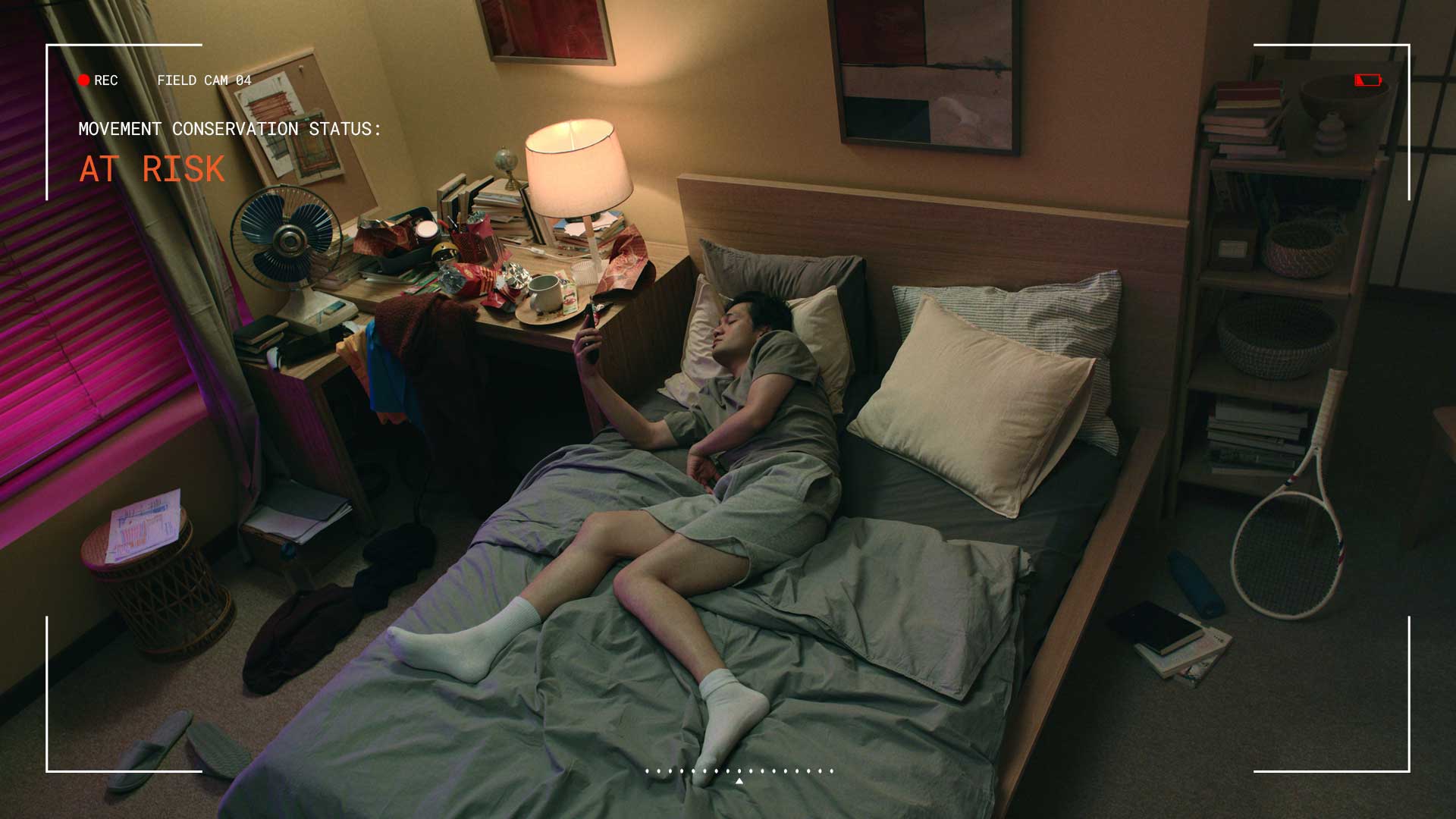
That is exactly the gaze ASICS chose for Human Nature, the documentary it is releasing for World Mental Health Day on October 10. It’s narrated by Sigourney Weaver, whom American viewers know as the voice of Planet Earth, and who returns to the genre here with a simple inversion: the lens trained on human beings, on the ever more comfortable habitats we’ve built around ourselves, on the couches and screens we’ve put in place of countless gestures our species performed for centuries without a second thought. The tone feels ironic, almost playful. The subtext, much less so.
Behind the film is the Movement Conservation Report, a study ASICS ran in July through an online survey of 34,000 people in 31 countries, a thousand of them in Italy. The first number is also the hardest to swallow. Worldwide, respondents say they spend 86% of their waking hours not moving, and the Italian sample climbs to 87%. Over a 16-hour waking day, that comes to nearly fourteen hours of stillness.
To give these numbers a shape, ASICS worked with Brendon Stubbs, a researcher at King’s College London who has spent years studying the link between physical activity and mental health. The result is the Movement Conservation Status, a classification borrowed from wildlife protection and built on the World Health Organization’s guidelines. Anyone above 150 minutes of movement a week is “Active.” Between 30 and 149 minutes, you’re “At Risk.” Under half an hour a week, “Endangered.”
I stayed with that word for a long time. Endangered. We use it for distant animals, photographed through a telephoto lens, whose survival depends on how much room we’re willing to leave them. Applied to our own species it sounds like advertising hyperbole, until you look at the proportions. Worldwide, nearly one person in four falls into that last band. In Italy, half of all adults sit below the Active threshold, and if habits stay as they are, the share will reach 55% by 2035: roughly 27 million people.
By that classification I’d be safe, comfortably above the line. The trouble is that the line is drawn across a week’s worth of minutes, and that Tuesday happened entirely in the hours it doesn’t count.
A Habitat Without Friction
To see how we got here, trace any errand backward. Until a few years ago, paying a bill meant going out, walking to the post office, standing in line with the payment slip in your hand, walking home. We called it a wasted morning, and it was also friction, a small resistance from the world that made your legs work before you got what you needed. Groceries, the bank teller’s window, the package to pick up, coffee with a friend downtown: every need came with a stretch of road attached, and the sum of those stretches, which nobody ever counted, was the movement of an ordinary day.
Then we removed the friction one piece at a time, and every single surrender had excellent reasons to exist. When ASICS asked people what had taken the place of movement in their lives, the most common answer worldwide was the smartphone, named by 57%, followed by social media, online shopping, food delivery apps, and working from home.
In Italy, 36% regularly handle online the errands they once ran in person, 33% often see other people through a phone or a video call, and among 18-to-24-year-olds that share rises to 46%. One Italian in three says they could stay home for three days or more without any trouble.
Nobody got lazy. The habitat changed.
“We’ve built a world that makes movement optional.”
That’s how David Raichlen, professor of biology and anthropology at the University of Southern California, sums up the findings. His lab has spent years on a hypothesis that makes the line sharper still: when our ancestors shifted to hunting and gathering, their daily physical activity grew to the point that the body came to depend on it, from the health of the brain to the health of the bones. Seen that way, movement looks more like an operating condition, a requirement we’ve carried since prehistory, written into our tissues.
We rewrote the environment in a few decades. The biological contract is still the one we signed on the savanna.
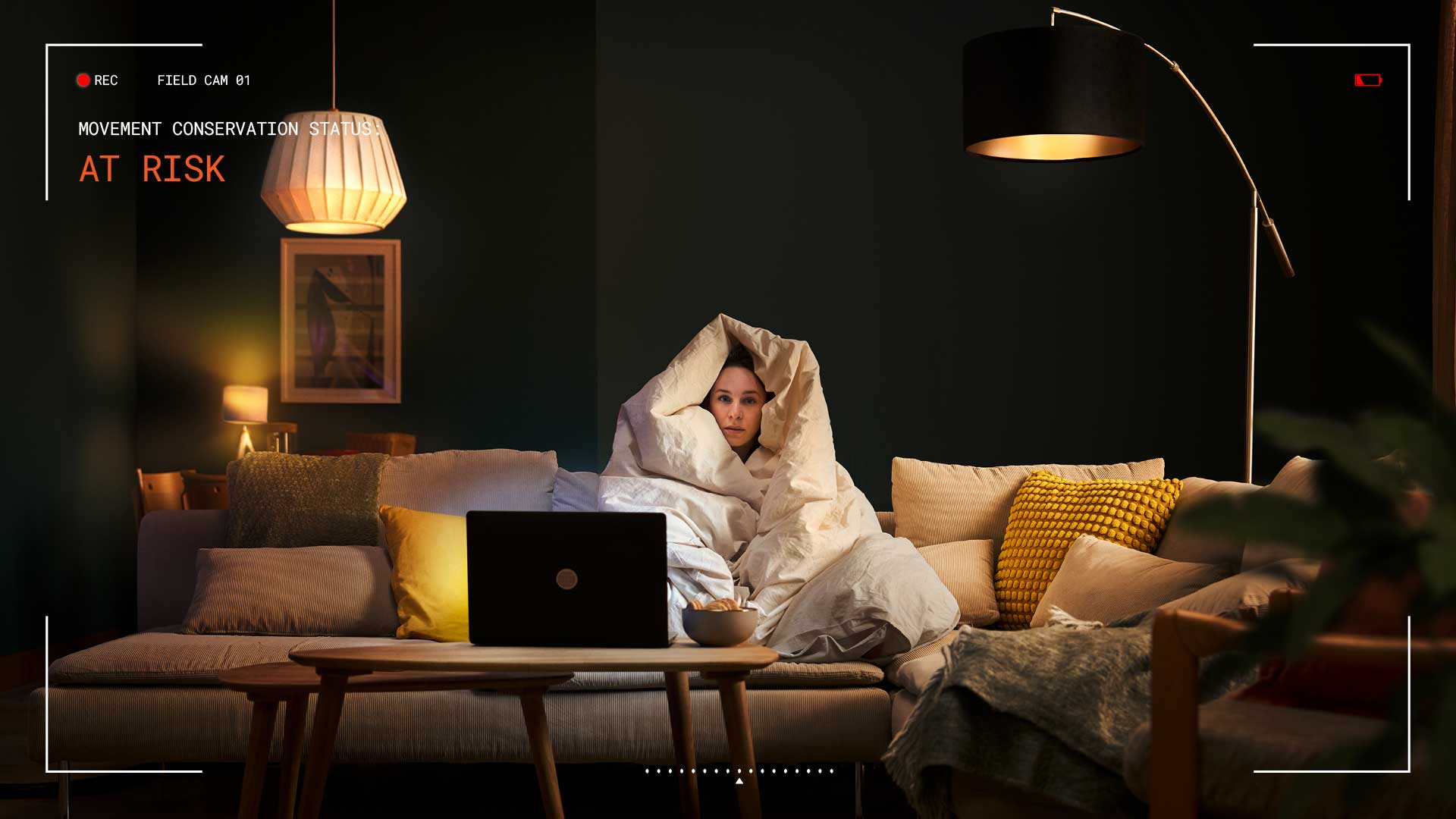
Some are trying to put friction back into our days from the top down. But the habitat where we spend those fourteen hours is our own home, and only we can reach it.
There’s also an irony in this whole operation worth looking at squarely. Human Nature is a film about how much we sit, and nearly everyone who watches it will be sitting in front of a screen. It comes from a brand that makes shoes for running and plenty of other sports, and that, instead of asking us for a marathon, asks for fifteen minutes. At first glance these look like two short circuits. Look closer and they’re the best part of the project. The nature documentary was born for the living room, and using it to talk about the couch means going to find viewers in the one place you’re certain to find them. As for setting the bar so low: by placing it there, a company that equips people who rack up miles takes the conversation back upstream of any kind of performance, and hands it back to the whole species.
What You Feel in Your Head
I know the days I don’t go out all too well. Around five in the afternoon my head turns into a room whose windows have been shut for too many hours: the air is still, my thoughts keep circling the same two objects, my focus goes slack like a rubber band stretched a thousand times. It feels closer to dust than to fatigue, because nothing I did all day was tiring.
When ASICS asked what effects people attribute to moving too little, the symptom mentioned most often worldwide was lethargy. In Italian, the word shares its root with the word for hibernation, the state in which some animals nearly stop moving to get through the winter. They do it to survive the cold. We get there in October, with the heat on and the fridge full.
To measure that dust, ASICS uses an index called State of Mind, the average of ten emotional and cognitive dimensions on a 100-point scale. In Italy, people in the Endangered band average 59, against 71 for the Active. The Italian figure that weighs most, though, concerns those who very often spend whole days without setting foot outside: their score drops to 55, against 73 for those who never do, and their likelihood of landing in the Endangered band triples, from 16% to 51%. In the global average both gaps are narrower: nine points instead of eighteen, a likelihood that doubles rather than triples.
Then there are the young. In Italy, 59% of 18-to-24-year-olds fall short of recommended levels, compared with 45% of those over 65, and 89% of them say they feel at least one effect of moving too little, mostly in motivation and mood, along with higher stress. These are self-reported answers, gathered by asking people to describe themselves, and they should be read as a picture of how we see ourselves. That is exactly why they carry weight. What emerges is the portrait of a generation that knows it isn’t moving and feels in its own skin what that costs, which means it already knows which way to go.
A Fifteen-Minute Reserve
The part of the research worth holding onto is the smallest. According to the data ASICS collected, fifteen minutes of movement can be enough to produce a measurable lift in mental state. Fifteen minutes is a long phone call, or the walk to the bakery on the far side of the neighborhood.
The brand’s very name comes from a Latin phrase, Anima Sana In Corpore Sano. It’s a variation on a line by Juvenal, who in his Satires counted a sound mind in a sound body among the few things worth praying to the gods for. Juvenal wrote mens, the mind. ASICS chose anima, and in Latin anima is first of all breath, the air that moves in and out of the lungs. Anyone who has walked up a steep hill knows the two belong together better than philosophy has ever managed to prove.
In nature conservation, endangered species are protected with reserves, stretches of land set aside from everyday use where room is left for what would otherwise disappear. Fifteen minutes a day is a reserve of the same nature, carved out of a habitat where walking no longer serves any purpose. For World Mental Health Day, ASICS is inviting everyone to set those minutes aside and join a global community of people who look after them, the Movement Conservationists. A species that, for once, is taking charge of its own protection.
On Wednesday at noon I closed my laptop and walked to that bakery. Twelve minutes there, twelve back, for a loaf I could have had delivered to my door. Coming home I skipped the elevator and took the stairs two at a time, the paper bag warming against my hip.
If a voice-over were following me, it would note that the specimen left its den with no apparent need. Of its entire day, it’s the only act nobody had made easy for it.