
When you use a compression garment-whether shorts or jerseys-the workout already starts with the dressing: in fact, to get certain garments on you already struggle. They are small, tight, they look, to the eye, like garments 2/3 sizes smaller than yours. To mistake them for children’s clothes is quite common. When you have worn them, however, you can witness one of the most pleasant phenomena caused by compression clothing: the shaping of your body.
In fact, a compression garment does not uniformly compress the entire body but works at zones of different density and pressure so that it acts more effectively on the tissues and blood vessels they contain. In fact, the purpose of compression clothing is to exert pressure on the veins so as to accelerate their flow and, consequently, the supply of oxygen to the muscles.
It is not a fad
The question about this type of clothing is, “What exactly is it for?” Imagine that your muscles are bandaged constantly during training and, through their movement and the compression of the clothing covering them, are massaged. By reducing muscle vibration and increasing oxygen flow rate, this clothing reduces their exhaustion resulting from physical activity, greatly accelerating recovery. In addition, increased oxygenation also allows for more “activated” and responsive muscles.
From head to toe
For this test I dressed from head to toe with products from the very Italian Oxyburn: Drop jersey, Axo pants and Potency socks. After wearing them, if the knees are excluded, I find myself completely covered in compression clothing. Looking in the mirror I see someone I know but in a more toned and sculpted body. Perhaps the training to dress me has already worked, or, more simply, the compression is already acting by shaping a decidedly more sculpted body than I am used to. That alone is a plus: if it makes you look better and more comfortable, it has already done something. But then you go out for a run.
One function you appreciate early on about this clothing is its ability to contain your muscles, supporting them and improving your running setup. It makes you more efficient in a way, because it perfects the athletic gesture. But it does not constrain or impede; on the contrary. After a while you forget about it and proceed with the feeling of wearing light armor.
The fabrics from which these garments are made are also antibacterial and hypoallergenic (they are made of Dryarn® polypropylene), so they smell less after being used, partly because they are still very breathable due to the structure of their spinning.
According to Oxyburn’s classification, those used in this test are level 2 compression, so medium. In short, there are milder ones and even more fasciating ones.
Each garment produces a bandaging and restraining effect, but you should not think of it as annoying, in any way: after a while you don’t mind it anymore and just feel the support they give you.
Forget the technique
While these are very technical garments built with the best spinning technologies and the most advanced materials, Oxyburn itself insists – in my opinion rightly so – more on the freedom they give the runner to be comfortable and reconnect with the outdoors and nature. I could tell in detail how they are made and with what yarns, but after all, doesn’t it matter more what they feel like during their use and especially afterwards?
During you forget them, despite the initial dressing phase in which you feel them adhering and “pressing” against your body. Both the jersey and the pants perform in the most extensive manner a compressive action that does not leave an inch of skin free, massaging the muscles in the process.
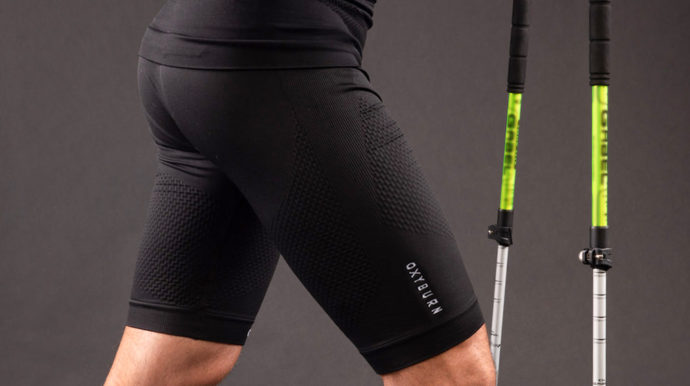
You feel your muscles much less fatigued afterward and recover your optimal form more quickly. These are also garments that you can use in other disciplines, such as biking or skiing, for example. They are indeed warm and hold an optimal body temperature, so much so that I have often used them as a single layer. Spinning itself produces a fabric of a certain thickness so, swaddled with them, you don’t have to fear somewhat cold temperatures.
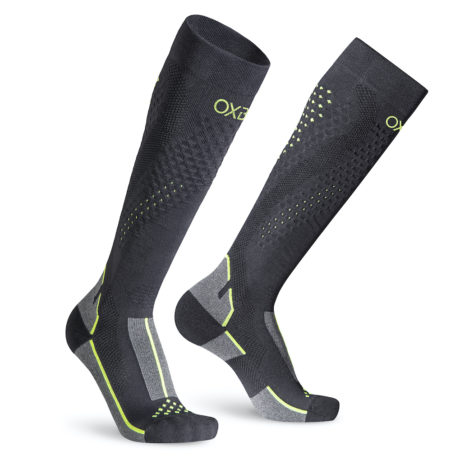
A special mention for the Potency socks: given their thickness, one might be concerned that they will overheat the foot, which by the way is highly stressed by use during running. Instead of air-conditioning fluorine nanoparticle inserts, they reduce the internal temperature by as much as 2°C. And in addition, the differentiated texture in the sole area of the foot creates a kind of cushioning pads that make them even more comfortable.
A final consideration
To return to the original question-that is, whether compression clothing really serves any purpose-the answer is yes. You may decide to have some such items in your running wardrobe for various reasons:
- For the most stressful workouts, to therefore recover faster after
- As clothing suitable for colder temperatures (but there are lighter, “summer” compression garments)
- Because they provide special comfort, which is also enabled by the construction techniques with which they are made
- Because, particularly these from Oxyburn, they cost a little more (but not that much more) and last a lot longer: the Drop shirt costs 64.90 euros, the Axo pants 54.90, the socks 26.90. More than average but not that much more.
You should see them as specific garments, very technical but not for that reason complicated to use, more durable and performing. Try it to believe.