
In early June, Garmin
launched on the market
the new Forerunner 255, the direct heir and evolution of the 245, a watch designed first and foremost for running (road, track, trail, etc.) but which winks at, or rather I would say embraces, the multisport field. I’ve been using it for a few weeks and a few hundred miles of running, and I think I’ve gotten a pretty good idea of what kind of device it is.
DIMENSIONS AND MATERIALS
The Forerunner 255 is a leap forward from its predecessors in the Forerunner 2XX series right from the size, going from the 41 mm case in its predecessors to the current 46. This results in an increase in display size and an optical effect on the wrist that is noticeable. What does not make itself felt, however, is the weight. In fact, at 49 grams, you can barely feel it and almost forget you are wearing it. The plastics are of very good quality, and the silicone on the strap is soft and flexible, but it also returns a good feeling of resistance to tension and twisting. The construction follows the usual Garmin pattern for sportwatches, with two physical buttons on the right and three on the left, each assigned to one or more features and menu options (of which there are indeed many). The upper right key, moreover, is doubly highlighted by a colored ring and itself of a different color from the other keys. It is, in fact, the most important button, the one with which you start and stop activities, and its differentiation also gives the watch an aesthetic improvement (in my opinion at least). The color of the ring is also echoed under the case crown and in the line highlighting the position of the inscription
START
, which is also colored. The case crown is always black, whichever watch color you choose. There are two main sizes: Forerunner 255 (with a 45.6 mm case) and Forerunner 255s (with a 41 mm case); each of which has a Standard and a Music variant, which-as the name implies-allows you to store and listen to music directly from the device, pairing it, of course, with compatible Bluetooth headphones.
DAILY AND SPORTS FUNCTIONS
The Forerunner 255 comes with a great ambition, that of being a sportwatch that can be used even when not doing sports, accompanying us throughout the day, for every day of the week. We can already feel it at the mere sight of how it looks on the wrist thanks to the size of the case, and then go into more technical detail for the fourth-generation sensor for detecting heart rate and oxygen percentage, those of movement that allow us-among other things-to better monitor sleep, the evolution of computational algorithms to process the data, and last but not least a series of graphic devices that make the aesthetics much more in line with what we normally see in our smartphones.
The list of new things that can be appreciated on the 255 is really meaty, so I will just list the ones that impressed me the most, starting with those related to everyday life:
- The Daily Report
It is first on the list because it is the first thing 255 offers you as soon as you wake up. It is a summary of how the night went and what’s in store for you during the day, with a list of appointments on the calendar and any scheduled training. A quick glance that you have as soon as you wake up and can help you focus on things not to forget. HRV Status appears in this report, indicating the variability of heartbeats, recorded during sleep, an indicator of the state of your heart health and-indirectly-of your entire body.

- Garmin Pay
This is not brand new, of course, but it is one of the introductions that I have personally enjoyed very much for life outside the race. I often pay digitally and being able to do so directly with the watch is most convenient, introducing this mode on the Garmin 2XX series as well was a really good choice on Garmin’s part.
- The immediate post activity report
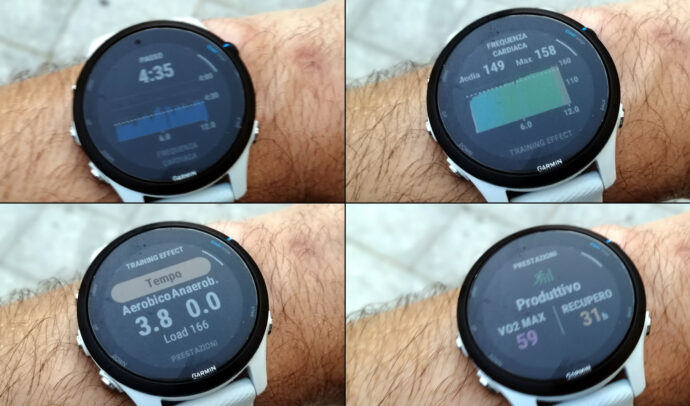
As soon as a run is saved, information about what the algorithm calculated based on the information we fed to the watch via information about our physical characteristics and what it recorded in previous activities appears on the screen, in addition to the summary regarding time and distance. Like many other recent models, the Forerunner 255 uses Physio TrueUp data synchronization with any previous Garmin, so it goes and learns something about our bodies very quickly. The novelty here is purely graphical, with new display modes for heart rate and new data arrangements, better than the previous model of which the 255 is a direct evolution.
- The Acute Load, Load Focus and Pace Pro
These are also features already present on more advanced series models, carried and optimized on the Forerunner 255 as well. In particular, from my perspective at least, I noticed how the Acute Load calculation has improved, which is based on the last seven days but now dynamically calculates the load, so the value we have today, although it takes into account and put on the scales what was done in the last week, is closer to the most recent day and thus returns a more reliable assessment for our run results. Although to speak only of running would be reductive, because the activities possible on the Forerunner 255 are many, and training loads and the Pace Pro feature are self-powered by all these activities.
- The Triathlon
Perhaps the most obvious qualitative leap in terms of the sports activities that are possible with the Forerunner 255. If already in the previous watches of the 2XX series it was possible to set different activities, including of course swimming and biking, with the 255 comes the introduction of the Triathlon function, which allows you to do in one activity the three sports in the succession and with the typical triathlon changes, and actually elevates the device on a higher category than other watches in the same market range.
WHAT WAS ALREADY THERE, BUT “NOW IS BETTER”
The Forerunner 255 has a list of features and activities that would be almost impossible to list, or at least it would not be possible to do so without going really long (yes, this review is short compared to what it can do). It inherits, as mentioned, all the functions and activities of previous models and improves on them.
A shortened list with a very small description:
Garmin Coach
: You can also use Garmin Coach’s customizable, personalized training plans on the 255, a detailed description of which can be found here
here
(part 1) and
here
(part 2).
Running Dynamics
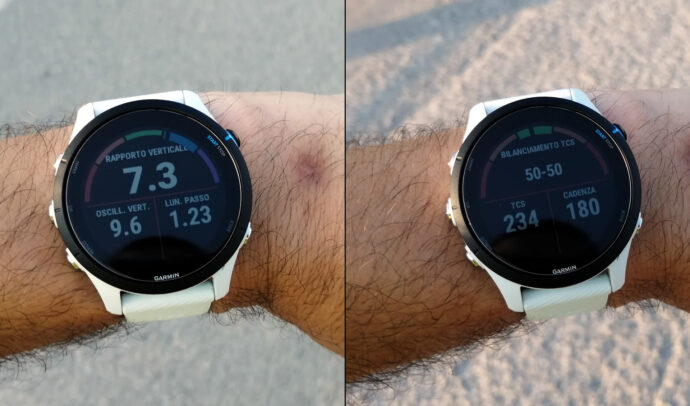
: This function is one of the classics of Garmin devices. It requires the use of an HRM band or a Running Pod and provides, in real time, indications of running dynamics such as stride length, vertical swing, ground contact time, and contact percentage of each foot. A must for evaluating one’s running technique and tracking improvement.
- Incident Detection / Assistance: when the motion sensor detects an abrupt freeze that could be associated with a fall or bumping into something, it initiates the assistance system, which detects the location and sends it, along with a message for help, to the contact we have set as the emergency contact. Already
present on the Forerunner 245
, it has been improved in both hardware and software.
Music
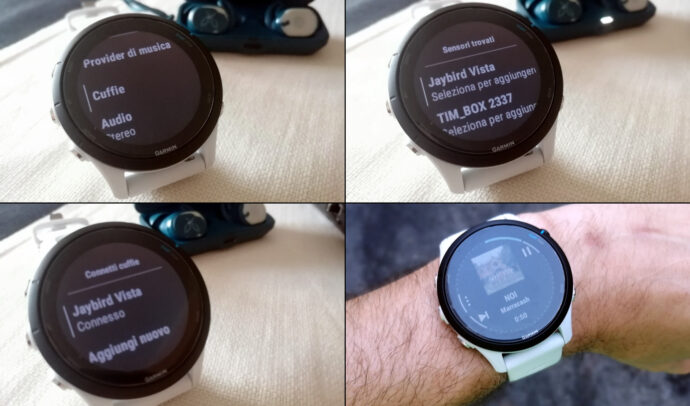
: in addition to the ability to connect to popular web services such as spotify and amazon music, it is possible to use the storage space to put in our favorite songs and listen to them during our rides through compatible bluetooth headphones. As far as my use is concerned, I have never had a skip in track or headphone connection, and the transmission has always been smooth, both for personal tracks and podcasts listened to via spotify.
THE ROAD TEST
We come to the most important thing, which is the ability to record our runs.
The Forerunner 255 uses the same multiband GPS system as the Forerunner 955 and the Fenix 7, which always took only a few seconds (about twenty at most) to lock onto satellites and was extremely accurate, never a smudge, perfect on the track (with the Track running) and repetitive on known path, thus giving evidence of consistency in registration and position detection. Running practically on the sea, in this, probably helped the Forerunner 255’s new sensor, which had virtually free field for satellite detection at all times, and although there are few notable climbs, looking at the altimetry detail the changes in slope were recorded correctly. The new barometric sensor for pressure and altitude changes has a major impact on this aspect.
Battery life was also very satisfactory. I started the test at exactly midnight between Sunday and Monday, unplugging the watch from the charger at 100%, and put it back on charge almost exactly one week later, on the following Sunday evening around dinner time, with about 3% charge remaining. In between these two time intervals, the Forerunner 255 was able to accompany me for a total of 7 hours of running (a little more or a little less than an hour a day), with the Bluetooth connection always on and notifications for messaging, email, and phone apps active. Really good, in my opinion.
FOR WHOM IT IS RECOMMENDED
The Forerunner 255 is a very advanced sportwatch devoted primarily to running that can be used by both amateur and advanced runners, and can also accompany those who practice triathlons or otherwise several sports activities and want to record them all with a single device.
It has a battery that can accompany us for several days in smartwatch mode and certainly for an entire triathlon activity, as well as obviously for a long-distance race such as a Marathon or even an Ultra Marathon. The generously sized screen also allows-and we could talk for hours on this topic-to indulge in customization through the use of the Connect IQ platform.
You can find the Forerunner 255 in the best sporting goods stores and on Garmin’s website at this
link
, priced at €349 for the standard version and €399 for the Music version.