
After the guide to the road models, we’re heading off-road with the same approach. On trails you pick a shoe by reading the ground rather than the clock: five ASICS models and the surface each one was built for.
- Three variables decide almost everything: how broken up the ground is, how many hours you stay out, and how often you run into wet.
- The BLAZEBLAST brings the road-going BLAST technology onto the trail, and it’s built for runners coming off pavement.
- For fast technical ground there’s the FUJI LITE 7, for the mountains the TRABUCO 14, for ultras the TRABUCO MAX 5.
- The METAFUJI TRAIL 2 puts an X-shaped carbon plate on the trail, race-tested by ASICS athletes.
The first stretch of singletrack after the pavement is always a small surprise. Your foot lands on something that shifts, the ankle corrects, and your eyes drop off the horizon to a spot ten feet ahead. From there the shoe stops being a detail. It’s the only piece of equipment touching the ground, and off-road, the ground makes you adapt to everything.
ASICS has been building trail shoes since the first FUJITRAIL, and this season’s lineup has an unusual quality: it covers five uses that barely overlap, from a first run on dirt to 100-mile races. Here’s how to navigate it, starting where you have to start.
The Three Variables That Matter Off-Road
How broken up the ground is. A valley-floor dirt road and a ridge trail full of loose rock ask for opposite things. On the first you can afford a tall, soft shoe; on the second you want a low platform and an outsole that bites. If you’re not sure how to classify the routes you run most, learning to read the ground is the first exercise to do, and it works in the store too.
How many hours you stay out. An hour in the woods and six hours in the mountains aren’t the same activity and, arguably, not even the same sport. Past three or four hours, the amount of foam under your foot stops being a preference and becomes protection: your joints absorb thousands of impacts, and you feel the difference in the days that follow.
How often you run into wet. Mud, dew-soaked grass, damp rock — these are the conditions where the rubber decides whether you stay upright.
Two numbers on every spec sheet come out of this. The first is lug height: lugs work like small blades that sink in where the ground gives way, so the taller they are the more they bite in soft stuff, while on firm ground a shallow pattern runs quieter and more comfortably. The second is drop, the height difference between heel and forefoot: a low drop keeps the foot closer to the ground and gives you control on technical terrain, while a more generous one takes work off the calf over long distances. The whole ASICS trail running collection is organized along exactly those lines.
1. From Pavement to Dirt: The Shoe to Start With
ASICS BLAZEBLAST
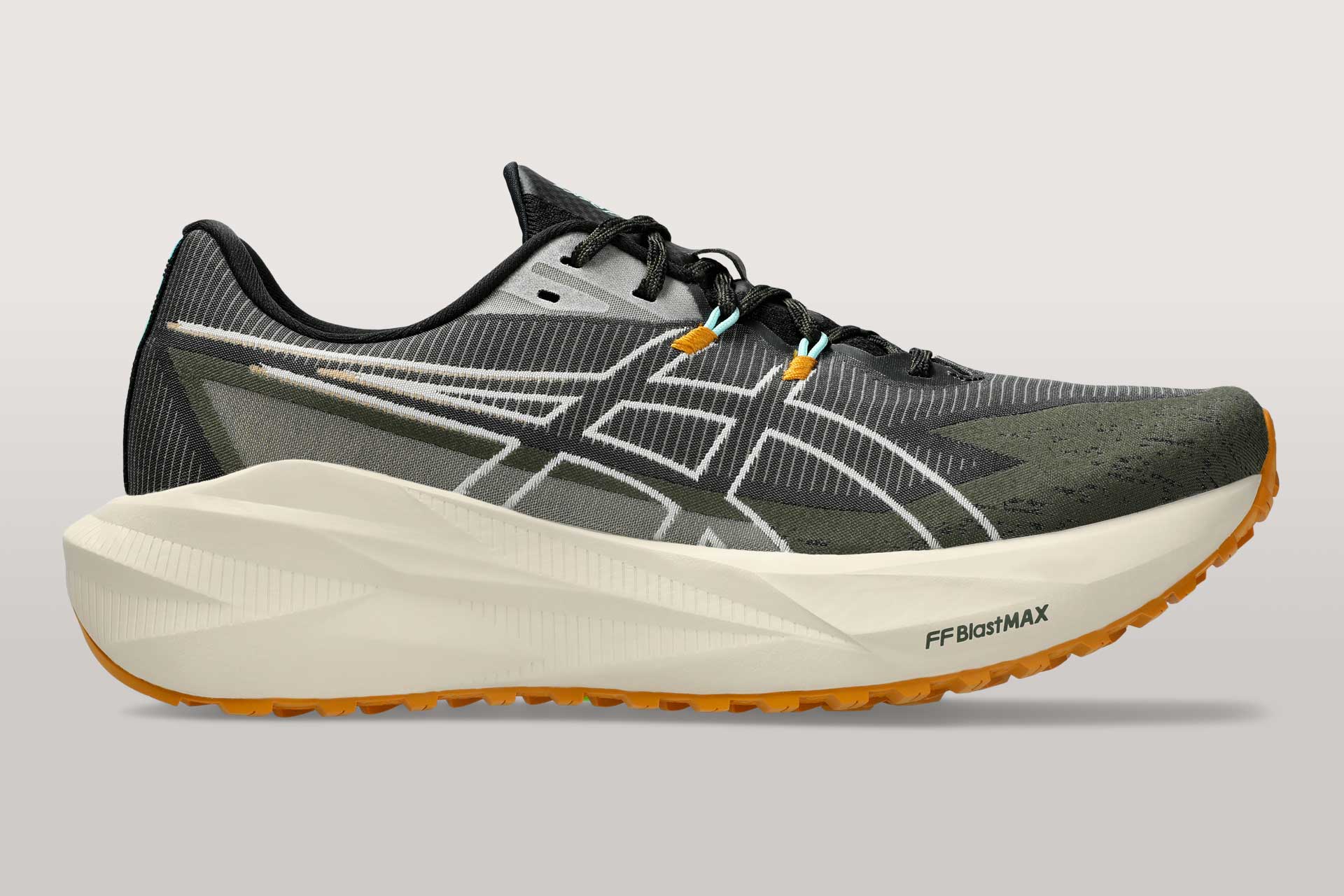
This is the new model of the year, and it grew out of something simple ASICS heard from runners: plenty of them wanted the bounce of their road shoes on the trail. The BLAZEBLAST is the first trail shoe in the BLAST family and uses FF BLAST MAX foam paired with a trampoline-style forefoot construction, the sole shaping that compresses at toe-off and hands the push back. The result underfoot is lively, soft, familiar to anyone arriving from the road. The woven technical upper stays light and breathable, and the ASICSGRIP outsole carries 2.5 mm lugs, tuned for flowing trails.
The numbers: 8.9 oz (252 g) men’s and 7.8 oz (222 g) women’s, 8 mm drop, 43 mm of midsole at the heel and 35 mm at the forefoot. It costs €160 and reached stores on August 1, 2026. Magdalena Gassebner, who followed its development at ASICS, has described it as a deliberate choice: instead of yet another hyper-technical shoe, a model that feels secure from the first run out. If you’re just starting, it also works beautifully on the hills behind your house, which are the right training ground before real mountains.
Best for: runners coming from the road, dirt roads and flowing trails, mixed pavement-and-dirt runs, first experiences off-road.
2. When the Trail Turns Technical and You Want to Feel the Ground
ASICS FUJI LITE 7

This one works against the general drift toward taller shoes. A restrained midsole, 32 mm at the heel and 28 mm at the forefoot, drop of just 4 mm: the foot stays close to the ground and registers what’s happening underneath, which on technical terrain is the best way to avoid a bad landing. Cushioning comes from the FF BLAST PLUS compound, lighter than traditional FF BLAST foam, and the ASICSGRIP outsole carries 4 mm lugs, so you get real purchase on dirt, wet grass and ground that crumbles underfoot.
It weighs 8.5 oz (241 g) in unisex sizing, about a third of an ounce less than the FUJI LITE 6, and the gain comes from the new woven upper, which is also tougher against rock and brush. The detail worth flagging is the tongue construction, the tongue wing: two flaps that wrap the midfoot and cut down the foot’s movement inside the shoe, the kind that sends your toes into the front bumper on downhill traverses. It costs €140 and is the most accessible entry point in the range. One caution: a low drop asks for prepared ankles and tendons, so if you’re coming from road shoes with 8 or 10 mm, it’s worth adding some strengthening work to your week.
Best for: technical trails, steep climbs and descents, short sharp runs, runners who want to feel the ground.
3. Mountains and Long Distances: The Two TRABUCOs
Same objective, two different approaches: to run better, longer and with more awareness. What separates them is the cushioning philosophy, which defines the character and the ideal terrain of each shoe.
ASICS TRABUCO 14

This is the most adaptable shoe in the catalogue, the one built on balance and predictability. The main update in this version is the move to FF BLAST MAX foam with two extra millimetres of material over the previous generation: softer landings, a more reactive toe-off, and a structure that holds up when the hours stretch out. The fit has been redesigned with more room up front, a detail that counts for a lot once the foot swells after a few hours, while the reinforced technical mesh upper and the gusseted tongue with integrated lace garage keep grit and debris out. Underneath, ASICSGRIP with 4 mm lugs.
It comes with a rock plate, a rigid sheet embedded in the midsole that behaves like the cutting board under a knife: the sharp stone you’d feel at full speed arrives far more muted, instead of concentrating under the arch.
It weighs 9.9 oz (281 g) men’s and 8.8 oz (249 g) women’s, half an ounce less than the model it replaces, with 8 mm drop and 35 mm of midsole at the heel. It costs €160. Ben Dhiman, an ASICS Trail athlete, has summed it up well by saying it gives you security where the terrain offers none: nimble on tighter singletrack, predictable when fatigue takes your precision away. There’s also a GTX version with a waterproof membrane at €170.
Best for: mountains, technical and rocky trails, half-day runs, runners after protection without losing agility.
ASICS TRABUCO MAX 5

When the hours pile up and the ground stays runnable, the MAX is the answer. It’s the most cushioned model in the trail range: FF BLAST PLUS for 38.5 mm at the heel, 5 mm drop, and a geometry that soaks up the repeated impacts of long descents. The updates in this fifth generation concentrate on the upper, now in water-repellent technical mesh and reinforced where the shoe wears through first, with a weave designed to let air in and water out after a stream crossing.
It weighs 10.7 oz (302 g) in the men’s version and 9.3 oz (264 g) in the women’s, just under half an ounce less than the TRABUCO MAX 4, and costs €180. It’s also the model with the lowest carbon footprint in the entire ASICS trail range: 10.7 kg of CO2 equivalent per pair, 26% below the industry average. On the runs it was made for, running is only part of the work, and knowing when it pays to hike shapes the outcome as much as the shoes on your feet.
Best for: ultra distances, all-day runs, runnable trails, runners who put comfort ahead of responsiveness.
When You Need a Waterproof Membrane and When It’s Too Much
The GTX version of a trail shoe adds a membrane that blocks water from the outside, and it costs about €10 more on average: the TRABUCO 14 GTX sells for €170 against €160 for the standard version. It’s worth it if you run through winter, if your trails have tall wet grass in the morning, or if you live somewhere it rains often, because a dry foot at 35°F is a question of comfort and of blisters. It makes less sense in summer and in any situation where stream crossings come thick and fast. In those cases you’re better off with an upper that drains quickly, like the water-repellent one on the TRABUCO MAX 5. The practical rule: membrane if the water comes from above and from the sides, draining upper if it comes from below.
4. Racing: Carbon Arrives on the Trails
ASICS METAFUJI TRAIL 2

The flagship of ASICS trail racing arrives with an uncommon backstory: the prototype raced at the highest level before it became a product. At Chamonix, in 2025, Tom Evans and Ben Dhiman were wearing it when they finished UTMB first and second. And this year Ben Dhiman confirmed it as a winning shoe by crossing the line first. Twenty-three athletes and seven successive prototypes went into the final version.
The technical news is the X-shaped carbon plate, designed specifically for off-road. A full plate, like the ones in road shoes, pushes well but stays stiff when the ground is uneven; the X geometry favours propulsion on the climbs and lets the two sides of the shoe adapt independently when the foot meets a stone or a root. On the descent, this helps maintain more precise contact with the ground. The plate works sandwiched between two foams: above it FF LEAP, the lightest and most reactive ASICS produces, below it FF BLAST PLUS, which handles comfort when the race stretches out. Rounding out the design are the Motion Wrap upper with elastomeric yarn, the sock-like collar with a pocket for quick laces, the SOLYTE sockliner and the ASICSGRIP outsole with 3.5 mm lugs.
It weighs 9.0 oz (255 g) in unisex sizing, 5 mm drop, 41.5 mm of midsole at the heel. It costs €250 and is available from August 1, 2026. Like every racing shoe, it asks for a base of miles already built: the propulsion is paid for in load on the calves and Achilles, and easing into it is part of using it correctly.
Best for: races from middle distance to ultra, trained athletes, runners chasing speed without giving up cushioning.
Summary Table
| Model | Best for | Weight men’s/women’s | Lugs | Drop | Price |
|---|---|---|---|---|---|
| BLAZEBLAST | First trails, flowing ground | 8.9 oz / 7.8 oz | 2.5 mm | 8 mm | €160 |
| FUJI LITE 7 | Fast technical, short runs | 8.5 oz (unisex) | 4 mm | 4 mm | €140 |
| TRABUCO 14 | Mountains, rocky trails | 9.9 oz / 8.8 oz | 4 mm | 8 mm | €160 |
| TRABUCO MAX 5 | Ultras and very long days | 10.7 oz / 9.3 oz | 4 mm | 5 mm | €180 |
| METAFUJI TRAIL 2 | Racing, middle distance and ultra | 9.0 oz (unisex) | 3.5 mm | 5 mm | €250 |
The Real Test Happens Uphill
A trail shoe gets judged in three moments: when you push on a climb, when you let off the brakes on a descent, and when, three hours in, you can still count on a precise landing. The first depends on weight, the second on the outsole, the third on the midsole foam. No spec sheet can tell you how those three moments will go for you, because they depend on your weight, your stride, your training and the trails near your house.
What a shoe’s characteristics can do is help you find your bearings. Put them on, find the steepest climb you know and the descent that usually gives you trouble. The answer comes sooner than you’d think.